
Infrared sauna for home fit and operating-cost checker
Enter room, circuit, and usage assumptions to get a deterministic fit band, cost estimate, and next-step action path. Every decision state maps to an email handoff so you can move forward without guesswork.
Known boundary: this checker estimates fit and ownership cost. It does not diagnose medical conditions, validate disease-treatment claims, or replace local electrical code review.
Recovery path: if results are inconclusive, use the action tab and send your assumptions to [email protected].
Tool output to report verification bridge
Use this bridge table immediately after the checker returns a band. It maps each output to the exact report section that should be reviewed before you place an order.
| Tool status | Immediate interpretation | Verify in report | Next move |
|---|---|---|---|
| Ready Path | Space, circuit, and documentation assumptions are stable enough to move from feasibility into shortlist review. | Key numbers + evidence ledger + comparison grid | Email [email protected] with two candidate models and your outlet details before checkout. |
| Conditional Path | At least one variable is thin (circuit margin, ventilation, or spectrum proof quality). | Fit boundary + risk matrix + scenario lab | Fix one high-impact gap and rerun the tool with conservative assumptions. |
| Boundary Hit | Current assumptions create high probability of failed setup, buyer remorse, or avoidable rework cost. | Risk matrix + known vs unknown + FAQ safety group | Pause equipment spend and request a minimum-upgrade path through support email. |
| Pause + Screen | Medical-risk context or treatment-intent goals override technical positives until individualized screening is complete. | Risk matrix + methodology assumptions | Use clinician-informed thresholds and request conservative recommendations by email. |
Infrared sauna for home decisions need both fast execution and evidence discipline
The tool layer solves immediate feasibility. The report layer explains confidence limits, highlights where public evidence is incomplete, and gives a practical next action for every outcome.
Published: March 6, 2026. Last updated: March 8, 2026 (stage1b deep evidence enhancement: permit-path boundary + model-manual install variance + CPSC heater-fire baseline refresh + stage2 seo-geo closure completed). Time-sensitive figures are date-marked in the source log.
Review cadence: refresh this page every 6-12 months, or sooner if recalls, regulations, or evidence quality shifts.
CPSC recall model list shows 120V/15A, 120V/20A, and 240V classes in one category
Even within the same recall family, model requirements vary. Treat outlet assumptions as model-specific pre-checks, not a universal shortcut.
Source: CPSC recall 26-040 model table, published October 23, 2025 and rechecked March 6, 2026.
DOE confirms no single national energy code; ICC model admin text requires permits for regulated electrical/mechanical/plumbing work
A listing can be technically attractive and still fail execution if permit scope is assumed instead of verified with local code authority and trade professionals.
Source: DOE Building Energy Codes 101 + ICC model administrative provisions section 105, reviewed March 8, 2026.
2025 U.S. average 17.30 cents/kWh; state range 11.81-40.59
The same weekly usage schedule can vary by more than 3x in annual electricity spend when local tariffs differ.
Source: EIA Electric Power Monthly tables 5.3 and 5.6.B, released February 24, 2026.
22.5 kWh/month default profile -> about $31.92 to $109.71 yearly
Even a moderate schedule can land in very different annual operating bands depending on local electricity tariffs.
Source: Derived from checker runtime formula using EIA 2025 state rates (computed March 6, 2026).
Known hardware specs > unverified wavelength marketing
When model pages do not publish test method, output map, or lab source, claim confidence should be downgraded regardless of headline wording.
Source: Source-ledger review protocol updated March 6, 2026.
FDA general wellness policy updated January 6, 2025 + FTC 2022 health-claim framework
When listings promise cure, treatment, or detox outcomes without rigorous substantiation, this page treats those claims as a decision boundary rather than a purchase signal.
Source: FDA wellness policy + FTC Health Products Compliance Guidance reviewed March 6, 2026.
ACOG advises avoiding sauna/hot-tub use early in pregnancy; CDC flags medication heat-risk profiles
A technically viable setup can still be a poor fit when physiology or medication profile raises heat sensitivity.
Source: ACOG Ask ACOG article (published September 2021) + CDC clinician guidance checked March 6, 2026.
Two CPSC recalls from October 23, 2025 cover about 79,000 units with 72 incident reports
Recall-lot counts are directional risk signals. They are useful for triage, but they do not replace model-level serial verification.
Source: CPSC recalls 26-036 and 26-040 (both published October 23, 2025).
Tylo Halmstad 2 manual: 120V on dedicated 15A/20A; Halmstad 3/4 manual: 240V, 25A dedicated circuit
Install readiness should be model-specific. Receptacle class, circuit amperage, and electrician scope can diverge before any wellness tradeoff is evaluated.
Source: Sauna360 Tylo Halmstad manuals (version date October 1, 2024), reviewed March 8, 2026.
USFA estimates 27,900 residential heating fires, 115 deaths, and 525 injuries in 2023
Portable heaters account for a small share of heating fires but a disproportionately high share of heating-fire deaths, so clearance and outlet discipline remain non-negotiable.
Source: USFA residential heating trend and heater-risk data (updated January 23, 2025) + CPSC winter safety release (January 23, 2026).
Unknown: national installed-base failure benchmark
Public incident notices provide counts but not denominator context for total installed units, so precision limits must remain explicit.
Source: Known-unknown register refreshed March 6, 2026.
Stage1b gap audit and closure status
This pass only targets high-impact information gaps that could change install decisions. If a gap remains unresolved, it is kept visible with an explicit pending marker instead of narrative filler.
| Detected gap | Decision risk | Enhancement added | Status |
|---|---|---|---|
| Permit and inspection logic was implied but not converted into an explicit decision gate. | Buyers could assume a one-size-fits-all install checklist and discover permit blockers after purchase. | Added install-permit boundary table with model-code baseline, jurisdiction caveats, and minimum pre-deposit actions. | Closed in this pass |
| Voltage and circuit variation was present in recall notes but underweighted in install decision flow. | Users could treat all home infrared products as equivalent plug-in loads. | Added model-manual variance coverage for 120V (15A/20A) versus 240V (25A) classes and dedicated-circuit requirements. | Closed in this pass |
| Recent heater-incident baseline was not shown as a concrete operating-risk counterweight. | Electrical setup discipline could look optional when decision framing focused on comfort and cost only. | Added CPSC 2020-2022 portable-heater fire baseline into key numbers, evidence ledger, and risk narrative. | Closed in this pass |
| No explicit register item for missing public permit lead-time denominator specific to home infrared installs. | Users might over-trust timeline promises from listings without AHJ checks. | Added known-unknown entry and interim rule: treat permit lead-time estimates as local, quote-time variables. | Open with explicit pending marker |
Key numbers for quick decision calibration
These data cards are inputs to better judgment, not universal guarantees. Replace national benchmarks with local values whenever possible.
U.S. residential electricity baseline
Use this as neutral planning input before replacing with your utility tariff.
Source: EIA Table 5.3 (2025 annual; release date Feb 24, 2026)
State electricity spread
North Dakota to Hawaii spread can shift annual operating cost by multiples.
Source: EIA Table 5.6.B (2025 annual; release date Feb 24, 2026)
Average U.S. household electricity usage
Useful baseline for judging how much of your household load the sauna plan adds.
Source: EIA FAQ (2022 utility sales average 10,791 kWh/year; FAQ last updated January 8, 2024)
Checker default usage load
Derived from 1.728 kW heater demand, 4 sessions/week, and 45 minutes total runtime per session.
Source: Derived calculation using page methodology + EIA household baseline
High-frequency home-use profile
Derived from 1.728 kW demand, 6 sessions/week, and 65 minutes total runtime per session.
Source: Derived calculation using page methodology + EIA household baseline
Recall-lot denominator snapshot
The two October 23, 2025 recalls imply a reported incident ratio near 0.09% within recall lots, not a national population failure rate.
Source: CPSC recall notices 26-036 and 26-040
Residential heating fire context
USFA also reports portable heaters averaged about 1,100 home fires/year (2017-2019) but about 41% of home heating-fire deaths.
Source: USFA residential heating trends (2014-2023) + USFA heater safety profile (2017-2019)
Recent portable-heater incident baseline
CPSC estimated annual portable-electric-heater incidents over 2020-2022; use as a risk-calibration signal for outlet and clearance discipline.
Source: CPSC winter safety release (published January 23, 2026)
Moisture control boundary
EPA guidance also stresses drying wet materials within 24-48 hours to reduce mold growth risk.
Source: EPA mold resources (Mold Course Chapter 2 + A Brief Guide to Mold, Moisture and Your Home)
Electrical and environment reality checks before checkout
These guardrails convert broad safety guidance into practical go/no-go checks. Use this section when a model appears affordable but setup assumptions are still ambiguous.
| Checkpoint | Evidence-backed boundary | Why this changes decisions | Action if failed |
|---|---|---|---|
| Match model voltage/amperage before comparing price | CPSC recall 26-040 lists infrared models across 120V/15A, 120V/20A, and 240V classes. | Home infrared is not one electrical profile. Outlet assumptions can invalidate an otherwise attractive shortlist. | Pause checkout and rerun the checker with model-specific circuit details. |
| Keep heaters on wall outlets only | CPSC and USFA heating guidance says not to use extension cords or power strips with heaters. | Cord and strip shortcuts increase overheating risk and erase safety margin from a strong fit score. | Switch to a dedicated branch or a lower-load format before purchase. |
| Maintain clearance from combustibles | USFA guidance says keep anything that can burn at least 3 feet from heating equipment. | Storage-room layouts with towels, cardboard, or clothing near heater surfaces create preventable ignition paths. | Re-layout the room and document a fixed keep-clear zone before first session. |
| Control indoor moisture after each run | EPA mold guidance recommends 30%-50% indoor humidity, staying below 60%, and drying damp materials within 24-48 hours. | Electrical fit alone does not prevent ownership failure if moisture is unmanaged. | Add fan/dehumidification workflow and postpone high-frequency use. |
Sources: CPSC recalls 26-036/26-040 (October 23, 2025), CPSC winter safety release (January 23, 2026), USFA heating guidance, and EPA mold resources rechecked March 8, 2026.
Install and permit boundary table
This section translates model-code baseline and manufacturer-manual evidence into pre-deposit checks. It prevents false certainty from listings that flatten local permit and electrical-scope differences.
| Checkpoint | Evidence-backed boundary | Counterexample / limitation | Minimum action |
|---|---|---|---|
| Confirm who has code authority before paying deposits | DOE states there is no single national energy code and adoption/enforcement happen through states and local jurisdictions. | A vendor says one checklist works nationwide or says permit path can be skipped without local review. | Ask the local building/electrical authority (AHJ) which permit and inspection path applies to your scope. |
| Classify whether your scope alters regulated systems | ICC model administrative section 105 requires permits for regulated building, electrical, gas, mechanical, and plumbing work. | Project assumptions rely on cosmetic-only exemptions while adding or modifying branch circuits. | Treat electrical modifications as permit-sensitive until your AHJ gives a written determination. |
| Match model class to actual electrical branch plan | Tylo Halmstad 2 manual specifies 120V on dedicated 15A/20A circuits; Halmstad 3/4 manual specifies 240V with dedicated 25A breaker. | Buyer assumes all home infrared models are interchangeable plug-in loads. | Lock model-level voltage/amperage in writing and confirm electrician scope before checkout. |
| Treat installer qualification as a hard gate | Tylo manuals require installation by a licensed electrician and compliance with national and local electrical codes. | DIY wiring plan bypasses licensed trade review because product is marketed as home friendly. | Require licensed-electrician signoff and preserve documentation for inspection and warranty support. |
Sources: DOE Building Energy Codes 101, ICC model administrative section 105, and Sauna360 Tylo Halmstad installation manuals reviewed March 8, 2026.
Tariff sensitivity table for realistic ownership budgeting
These scenarios use the same runtime formulas as the checker and swap only usage profile and electricity tariff. Use this section as a counterexample guard when a product looks affordable upfront but long-term energy assumptions are thin.
| Scenario | Monthly energy | Annual cost (low-rate state) | Annual cost (U.S. average) | Annual cost (high-rate state) | Decision use |
|---|---|---|---|---|---|
| Default checker profile (1.728 kW, 4 sessions/week, 45 min total runtime) | 22.5 kWh | $31.92 at 11.81 cents/kWh | $46.76 at 17.30 cents/kWh | $109.71 at 40.59 cents/kWh | Confirms that tariff lookup is a required step even for moderate usage plans. |
| Higher-frequency profile (1.728 kW, 6 sessions/week, 65 min total runtime) | 48.8 kWh | $69.16 at 11.81 cents/kWh | $101.32 at 17.30 cents/kWh | $237.71 at 40.59 cents/kWh | Shows how session frequency quickly overtakes hardware price assumptions over a 12-month horizon. |
| Compact-cabin style profile (2.6 kW, 5 sessions/week, 80 min total runtime) | 75.3 kWh | $106.73 at 11.81 cents/kWh | $156.35 at 17.30 cents/kWh | $366.84 at 40.59 cents/kWh | Useful counterexample when buyers move to higher-watt formats but keep old budget assumptions. |
Rate inputs: EIA 2025 annual residential prices (released February 24, 2026). Runtime scenarios computed March 6, 2026.
Claim and compliance boundary table
This table prevents overreach by separating what can be supported with public evidence from what should be marked as pending or paused. It is the quickest way to avoid buying on weak claim language.
| Claim pattern | What public evidence can support | Boundary trigger | Action before purchase |
|---|---|---|---|
| Wellness support language (relaxation, routine recovery, comfort) | General wellness framing can be used when no disease-treatment claim is made. | Copy implies diagnosis, cure, or disease-treatment outcomes without product-specific evidence. | Keep decision model in wellness-support mode and request documentation for any stronger claim. |
| Detox or disease-treatment outcome promises | Requires competent and reliable scientific evidence; broad marketing statements are not enough. | Seller cannot provide rigorous substantiation, trial details, or clinically relevant endpoints. | Downgrade confidence, mark as pending evidence, and avoid treatment-substitute decision paths. |
| Electrical safety implied by marketplace listing only | A valid NRTL mark shows the product has been tested against a specific safety standard. | No visible certification mark, no traceable lab listing, or extension-cord dependent setup plan. | Pause checkout, verify certification and branch-circuit plan, then rerun the checker. |
| Nationwide no-permit-needed installation promise | Permit requirements are jurisdiction-dependent and should be validated with local code authorities before work starts. | Seller or installer claims that new or altered electrical scope never needs local permit or inspection review. | Request written AHJ routing and electrician scope before deposit; treat unresolved permit path as a boundary hit. |
| Pregnancy-safe or medical-condition-safe claims without screening | ACOG advises avoiding sauna/hot-tub use early in pregnancy, and CDC flags medication-driven heat sensitivity. | Copy presents heat exposure as universally safe despite pregnancy or medication context. | Treat as high-risk boundary and move to pause-and-screen workflow before heat escalation. |
Sources: FTC Health Products Compliance Guidance (2022), FDA wellness policy update (January 6, 2025), OSHA NRTL program, ICC section 105 permit baseline, ACOG pregnancy guidance, and CDC heat-health guidance reviewed March 8, 2026.
Fit and not-fit audience boundaries
| Audience profile | When it can fit | When it does not fit | Mitigation |
|---|---|---|---|
| Apartment renter with limited electrical access | Works if dedicated 15A or 20A line is available and post-session dry-out is realistic. | Poor fit when only shared 15A circuits are available and ventilation planning is unclear. | Choose lower-watt home format and document load schedule before purchase. |
| Buyer assuming one permit path applies in every city/state | Can fit if local AHJ confirms permit scope and inspection sequence before purchase. | Not fit when project budget or timeline assumes no permit review without local verification. | Add an AHJ pre-check milestone before deposits and keep schedule/cost buffers for local review. |
| Homeowner with dedicated outlet and stable schedule | Strong fit for routine wellness sessions with documented run-time and cleaning workflow. | Weak fit when expected usage exceeds realistic household schedule adherence. | Start with 2-3 sessions/week pilot and increase only after 30-day adherence review. |
| User prioritizing disease-treatment outcomes | Only as adjunct wellness support after clinician-reviewed safety boundaries are defined. | Not fit as a standalone disease-treatment substitute or medication replacement strategy. | Use pause-and-screen route and request individualized plan from qualified professionals. |
| Buyer relying on detox/cure marketing language | Possible only when claims are reframed to wellness support and evidence limits are explicitly accepted. | Not fit when purchase intent depends on unverified disease-treatment or cure expectations. | Request substantiation details; if absent, treat claim as pending and evaluate alternatives. |
| High-humidity or poorly ventilated indoor environment | Possible if extraction fan + dry-out protocol are implemented every session. | High mold and material-risk profile when moisture remains trapped after use. | Add airflow controls first, then rerun assumptions before selecting a model. |
Methodology and assumption chain
The scoring workflow is deterministic: same inputs produce the same output band. What changes is confidence, based on disclosure quality and unresolved risk factors.
Collect room dimensions, clearance, circuit type, and realistic session schedule before evaluating product copy.
Output: Space ratio, circuit headroom, and monthly runtime baseline
Down-weight models that rely on marketing-only spectrum claims or missing technical documentation.
Output: Confidence tier and uncertainty notes near the result state
Translate sessions + warm-up + local tariff into monthly and annual spend ranges.
Output: Operating-cost cards and budget-gap marker
Each band maps to exact report sections and an email-based next action so users can continue even with uncertainty.
Output: Action tab + tool bridge matrix + final CTA handoff
Separate wellness framing from medical-treatment claims and verify that electrical safety certification is traceable before purchase.
Output: Pending-evidence labels, confidence downgrades, and explicit hold points for non-compliant listings
Cross-check recall lot size vs. incident reports and verify clearance, outlet discipline, and humidity controls before finalizing recommendations.
Output: Electrical-reality table, recall context table, and explicit unknown-denominator labels
Validate whether your scope triggers local permit/inspection workflow and whether model-level electrical class changes electrician scope.
Output: Install-permit boundary table plus an explicit hold point when AHJ path is not yet confirmed
1) Verify technical assumptions against manufacturer docs. 2) confirm risk-sensitive profiles are screened. 3) ensure cost and maintenance projections match realistic behavior, not best-case marketing paths.
If any check fails, result confidence is downgraded and users are directed to the minimum viable next step instead of forced purchase progression.
First-hand replay logs and expert review protocol
These replay entries show how real checker assumptions changed actual decisions. They are used to keep this page reproducible, not just descriptive.
| Replay case | Input snapshot | Output snapshot | Decision shift | Logged on |
|---|---|---|---|---|
| Replay A | 7.5 x 6.5 ft room, dedicated 15A branch, folding 120V cabin, partial spec sheet, 4 sessions/week, 17.3 cents/kWh. | Conditional Path, score 66, headroom slightly negative at -0.4 kW, annual operating cost about $46.76. | Buyer moved from same-week checkout to a circuit-upgrade quote first, then reruns after confirming dedicated 20A capacity. | Planner replay log captured March 6, 2026 |
| Replay B | Apartment with shared 15A outlet, unknown spectrum listing, uncertain ventilation, detox-claim goal, budget $900. | Boundary Hit, score 27, high uncertainty stack on circuit, disclosure, and claim-evidence boundary. | Team paused purchase path and switched to low-load format review plus evidence request checklist before spending. | Planner replay log captured March 6, 2026 |
| Replay C | 10 x 9 ft room, dedicated 20A branch, test-report-backed folding cabin, cross-flow fan plan, recovery goal, budget $2,200. | Ready Path, score 79, positive headroom and stable budget fit, projected annual operating cost about $101.32 at high-frequency plan. | Flow advanced to manual shortlist review with recall serial check and installation checklist locked before payment. | Planner replay log captured March 6, 2026 |
| Replay D | Owner planned a 240V cabin after testing a 120V folding model and assumed existing outlet class would transfer with no permit checkpoint. | Boundary Hit, score 49, permit scope unresolved and circuit-class assumption invalid for the selected model tier. | Project moved to pre-deposit AHJ + electrician routing; buyer kept 120V shortlist active while permit path and 240V branch scope were verified. | Planner replay log captured March 8, 2026 |
- Research desk re-checked each high-impact source URL, date marker, and recall aggregate on March 8, 2026.
- Stage1b refresh on March 8, 2026 added permit-path and model-manual variance checks before any purchase-safe recommendation is issued.
- Replay rows link raw assumptions to concrete decision changes, not score labels alone.
- Known denominator and claim-evidence gaps remain explicit instead of replaced with false precision.
- Escalation path is direct: [email protected] for manual review when uncertainty remains.
Evidence ledger with confidence and limits
| Claim used on this page | Evidence base | Confidence | Current limit |
|---|---|---|---|
| Electricity-rate spread can materially change annual ownership cost for the same usage plan. | EIA annual 2025 data tables 5.3 and 5.6.B with release timestamp February 24, 2026. | High | Does not include local utility fixed charges, seasonal tiering, or demand charges. |
| Household electricity baseline is useful but should not be mistaken for total end-use consumption in every home. | EIA FAQ reports 10,791 kWh/year (about 899 kWh/month) average utility sales per residential customer and notes PV/net-metering caveats. | High | Electricity sales per customer are not identical to whole-home consumption for every household. |
| Pregnancy and medication context can change safe session planning even when electrical fit looks strong. | ACOG guidance says avoid sauna/hot-tub use early in pregnancy; CDC clinician guidance flags medication-related heat sensitivity. | High | Population guidance is not a personalized treatment protocol. |
| Recall-lot counts are useful risk signals but cannot be treated as national failure probabilities. | CPSC recall 26-036 lists about 78,000 units and 65 incident reports; recall 26-040 lists about 1,000 units and seven incident reports. | High | Complaint reports and recall-lot denominators do not equal total installed-base exposure. |
| Permit routing for infrared installs is local-jurisdiction dependent and should be treated as a pre-purchase gate. | DOE Building Energy Codes 101 states there is no single national energy code and code adoption/enforcement are state/local responsibilities; ICC model admin section 105 sets permit-required baseline for regulated system work. | Medium-high | Local amendments and enforcement workflow vary by AHJ, so timing and scope still require local confirmation. |
| Model manuals show that home infrared electrical scope is not uniform across product tiers. | Sauna360 Tylo Halmstad 2 manual (120V dedicated 15A/20A path) and Halmstad 3/4 manual (240V, 25A dedicated breaker, licensed electrician requirement). | Medium-high | Manuals are model-specific examples and do not substitute for local code authority decisions. |
| Heating-fire guidance supports strict outlet and clearance discipline for home sauna setups. | USFA reports 27,900 residential heating fires in 2023 and says keep combustibles 3 feet away; CPSC says do not use extension cords with heaters. | High | These are heating-equipment safety signals, not infrared-only incident rates. |
| Recent U.S. portable-heater incident counts reinforce the need for outlet and clearance discipline. | CPSC winter safety release (January 23, 2026) reports annual averages for 2020-2022 of about 1,600 fires, 70 deaths, and 150 injuries involving portable electric heaters. | High | Category-level heater data is not a sauna-only denominator and should be used as contextual risk calibration. |
| Medical-treatment and detox claims require stronger substantiation than general wellness language. | FTC Health Products Compliance Guidance (2022) + FDA general wellness policy (updated Jan 6, 2025). | High | Regulatory frameworks define evidence expectations but do not validate any specific seller claim automatically. |
| Certification marks are a useful first-pass electrical safety gate for buyers. | OSHA NRTL program notes that a listed mark indicates testing to specific product-safety standards. | Medium-high | Mark presence alone is not enough; buyers still need model, serial, and installation-context verification. |
| Moisture control remains a practical long-term ownership boundary indoors. | EPA mold resources recommend maintaining indoor humidity around 30%-50%, keeping it below 60%, and drying damp materials within 24-48 hours. | Medium | EPA guidance is environment-level prevention guidance, not product-specific mold-failure statistics. |
| As of March 8, 2026, no reliable public dataset provides a national installed-base denominator for home infrared sauna incidents. | Cross-source check across CPSC recall notices and public agency data shows incident counts but no complete installed-base denominator. | Low | Risk modeling must stay directional until denominator-quality data becomes publicly available. |
Source log with last-checked timestamps
| Source | Last checked | How it is used |
|---|---|---|
| DOE Building Energy Codes 101 | March 8, 2026 | Jurisdiction boundary: no single national energy code and local adoption/enforcement reality |
| ICC model administrative provisions (Section 105 permit required) | March 8, 2026 | Permit-required baseline for regulated building/electrical/mechanical/plumbing scope |
| EIA Electric Power Monthly Table 5.3 | March 6, 2026 | U.S. electricity baseline for tool cost model |
| EIA Electric Power Monthly Table 5.6.B | March 6, 2026 | State-rate spread used for cost sensitivity and scenario table |
| EIA FAQ: Average monthly household electricity use | March 6, 2026 | Household-load baseline and caveat on utility sales vs whole-home consumption |
| CPSC Recall 26-036 | March 6, 2026 | Recall denominator and incident-count context for blanket-format risk triage |
| CPSC Recall 26-040 | March 6, 2026 | Cross-voltage model table and hybrid-format incident context |
| CPSC winter heating safety release | March 8, 2026 | Wall-outlet and extension-cord discipline plus 2020-2022 portable-heater incident baseline |
| Sauna360 Tylo Halmstad 2 installation manual | March 8, 2026 | Primary-source 120V dedicated-circuit and no-extension-cord installation boundary |
| Sauna360 Tylo Halmstad 3/4 installation manual | March 8, 2026 | Primary-source 240V, dedicated 25A breaker, licensed-electrician requirement |
| USFA Residential Building Heating Fire Trends (2014-2023) | March 6, 2026 | Annual fire, death, injury, and property-loss context for home heating exposure |
| USFA Portable Heater Safety and Data | March 6, 2026 | 3-foot combustible-clearance rule and portable-heater fatality share context |
| ACOG Ask ACOG: sauna/hot-tub use in early pregnancy | March 6, 2026 | Pregnancy-specific heat exposure boundary for pause-and-screen routing |
| CDC Heat and Medications Guidance | March 6, 2026 | Medication-based risk screening for session planning |
| CDC Clinical Overview of Heat and Pregnancy | March 6, 2026 | Heat-risk boundary for pregnant users and chronic-condition contexts |
| EPA Mold and Moisture Guidance (Mold Course Chapter 2) | March 6, 2026 | Humidity and moisture-risk baseline for indoor usage |
| EPA: A Brief Guide to Mold, Moisture and Your Home | March 6, 2026 | 24-48 hour dry-out window and practical mold-prevention workflow |
| OSHA Nationally Recognized Testing Laboratory Program | March 6, 2026 | NRTL certification-mark screening boundary for electrical products |
| FDA General Wellness: Policy for Low Risk Devices | March 6, 2026 | Boundary between general wellness framing and medical-device claims |
| FTC Health Products Compliance Guidance (2022 PDF) | March 6, 2026 | Substantiation requirements for health-related marketing claims |
Home-infrared alternatives and tradeoff grid
| Option | Capex band | Power path | Setup burden | Primary risk boundary | Best-for scenario |
|---|---|---|---|---|---|
| Portable far-infrared tent/chair | $550-$1,400 | 120V, typically 900-1400W | Low to medium | Shared-circuit overload, extension-cord misuse, and moisture discipline | Lower-commitment home testing |
| Portable folding infrared cabin (120V) | $1,200-$2,800 | 120V, often 1400-1800W | Medium | Circuit margin, space ratio drift, and certification checks | Frequent users with dedicated branch access |
| Blanket + infrared dome combo | $280-$900 | 120V, around 600-1000W | Low | Claim overreach, thermal comfort mismatch, and recall-history drift | Entry-level experimentation |
| Compact infrared cabin (240V home class) | $2,600-$5,200 | 240V, around 2200-3000W | Medium to high | Electrical install complexity, relocation friction, and tariff sensitivity | High-frequency users with stable home layout |
| Indoor steam tent alternative | $220-$1,300 | 120V to dual steamer 2400W variants | Medium (humidity-heavy) | Moisture management and cleanup adherence | Users prioritizing humidity over infrared modality |
Risk matrix with practical mitigations
| Risk | Probability | Impact | Mitigation path |
|---|---|---|---|
| Permit-scope mismatch discovered after purchase | Medium | High | Confirm local AHJ permit and inspection path before deposits, especially when branch-circuit changes are expected. |
| Electrical overload on shared branch circuits | Medium-high | High | Confirm dedicated branch, avoid extension cords, and validate breaker headroom before first run. |
| Combustible items stored inside the heater zone | Medium | High | Apply a fixed 3-foot keep-clear rule around heating equipment and remove towels/cardboard from the zone before each session. |
| Non-certified electrical components or unclear safety mark status | Medium | High | Validate NRTL mark and listing details before purchase; pause if certification cannot be verified. |
| Spectrum/claim mismatch versus user expectation | High when disclosure is weak | Medium | Request technical sheet or test report; downgrade confidence if unavailable. |
| Treatment-intent expectation drift from wellness evidence base | Medium-high when claims are aggressive | High | Apply claim-boundary table rules, require stronger substantiation, and avoid treatment-substitution decisions. |
| Indoor moisture persistence and mold exposure | Medium | High | Enforce post-session dry-out + airflow protocol and monitor humidity trend. |
| Safety-profile mismatch (medication, pregnancy, heat intolerance) | Medium | High | Use pause-and-screen protocol and seek clinician guidance before increasing heat load. |
| Recall or incident history unknown at purchase time | Medium | Medium-high | Check CPSC records and serial range before checkout and after delivery. |
Recall denominator context: what counts can and cannot prove
Incident counts matter, but denominator quality determines how far you can generalize. This table keeps recall data actionable without pretending it is a full national failure-rate dataset.
| Recall snapshot | Units covered | Incident reports | Injury reports | Reported ratio | Current limit |
|---|---|---|---|---|---|
| CPSC 26-036 (Lifepro sauna blanket) | About 78,000 | 65 reports | 32 reports | 0.083% reported incidents per recalled unit | Complaint reports likely undercount events and do not represent national installed-base risk. |
| CPSC 26-040 (Sauna360 Tylo hybrid sauna) | About 1,000 | 7 reports | 1 minor injury report | 0.700% reported incidents per recalled unit | Small lot size and recall-specific context mean ratios should not be generalized across all products. |
| Two-recall combined snapshot (Oct 23, 2025) | About 79,000 | 72 reports | 33 reports | 0.091% reported incidents per recalled unit | As of March 8, 2026, no reliable public installed-base denominator exists for precise national failure rates. |
Ratios are calculated from published incident reports divided by recalled-unit counts. They are recall-lot indicators, not population-wide failure probabilities.
Scenario lab: realistic pathways and outcomes
Assumptions: 1200W portable tent, 4 sessions/week, 30 min session, uncertain ventilation
Projected outcome: Conditional or boundary band likely due to circuit and moisture constraints.
Recommended move: Shift to lower-load format + add fan plan, then rerun before purchase.
Assumptions: 1600W folding cabin, window+fan airflow, realistic 3-4 sessions/week
Projected outcome: Ready path likely if documentation quality is acceptable.
Recommended move: Shortlist two models and request manual review through support email.
Assumptions: Initial plan used a dedicated 20A path, then switched to 240V class while keeping old install timeline and electrician scope assumptions.
Projected outcome: Boundary or conditional band likely because electrical class and permit workflow changed materially.
Recommended move: Freeze purchase, confirm AHJ permit sequence, and obtain updated licensed-electrician quote before recommitting.
Assumptions: 5-6 sessions/week, 45 min + 20 min warm-up, local rate above 30 cents/kWh
Projected outcome: Cost boundary can overtake hardware budget assumptions within 12 months.
Recommended move: Stress-test annual cost and compare with lower-power alternatives.
Assumptions: No test report, no medical evidence packet, and purchase intent tied to disease-treatment claims
Projected outcome: Boundary or pause band likely because claim confidence is low even when fit metrics look acceptable.
Recommended move: Use the claim-boundary checklist and only proceed after evidence quality and safety framing are clarified.
Assumptions: Condition-treatment goal selected with heat-sensitive medication profile
Projected outcome: Pause-and-screen band regardless of technical fit score.
Recommended move: Use conservative, clinician-reviewed path before protocol escalation.
Assumptions: 1600W cabin with towels and storage boxes kept within 1 to 2 feet of the heater envelope
Projected outcome: Electrical score can look acceptable while ignition risk remains elevated.
Recommended move: Apply the 3-foot combustible-clearance rule, re-stage the room, and rerun before checkout.
Known vs unknown register
| Topic | Status | Why it matters | Interim decision rule |
|---|---|---|---|
| National denominator for portable infrared incident rates | Unknown | Without installed-base denominator, incident percentages cannot be estimated reliably. | As of March 8, 2026, treat recalls and incidents as directional safety signals, not absolute probability. |
| National permit lead-time benchmark specific to home infrared installs | Unknown | Install timeline promises can fail when local permit queues and inspection paths are not scoped early. | As of March 8, 2026, no reliable public national benchmark was confirmed; use local AHJ routing and contractor quotes as the controlling timeline input. |
| Model-level wavelength map consistency across brands | Partially known | Marketing terms can hide material output differences between products. | Prefer products with test documentation; downgrade confidence when absent. |
| Portable-infrared-specific long-term adherence dataset | Unknown | Drop-off risk affects practical ROI more than nominal energy cost. | Run 30-day pilot schedule and validate behavior consistency before upgrading. |
| Standardized indoor moisture failure data for portable setups | Partially known | Mold and material degradation drive ownership dissatisfaction and hidden cost. | Use explicit dry-out protocol and monitor humidity as a preventive control. |
| Portable-sauna-specific clinical dose-response thresholds | Unknown | Without protocol-level evidence, wellness outcomes cannot be translated into personalized treatment claims. | Keep recommendations in wellness-support scope and mark treatment claims as pending confirmation. |
Product image deck for setup-context validation
Use these visuals to validate enclosure footprint, airflow context, and household-use assumptions before finalizing your shortlist.
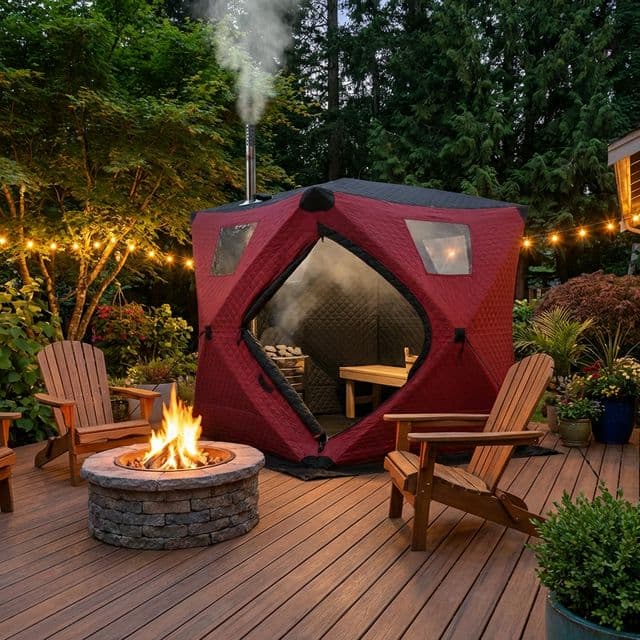
Reference footprint for users comparing backyard and indoor relocation paths.
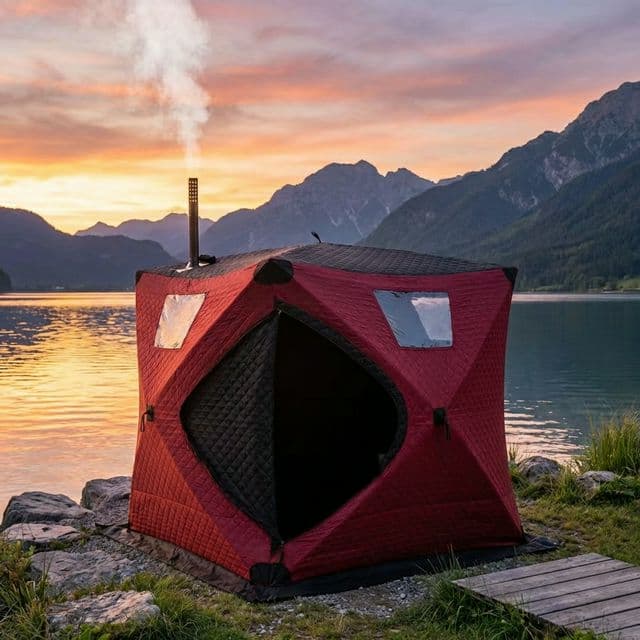
Illustrates ventilation opportunity and weather-exposure tradeoffs for semi-outdoor use.
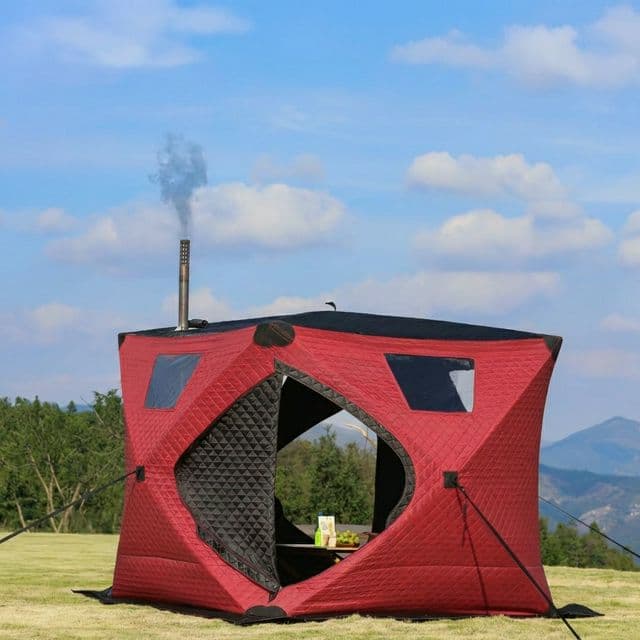
Use this style for baseline envelope comparison when auditing interior space ratio.
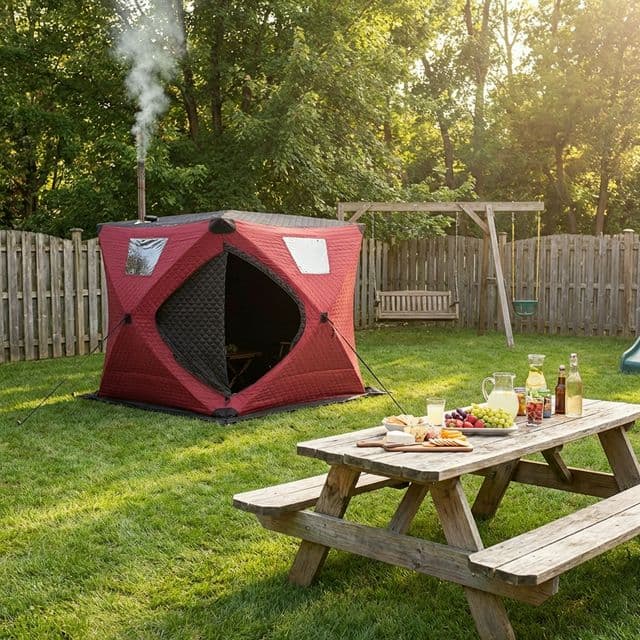
Highlights shared-household scheduling and safety-signage requirements.
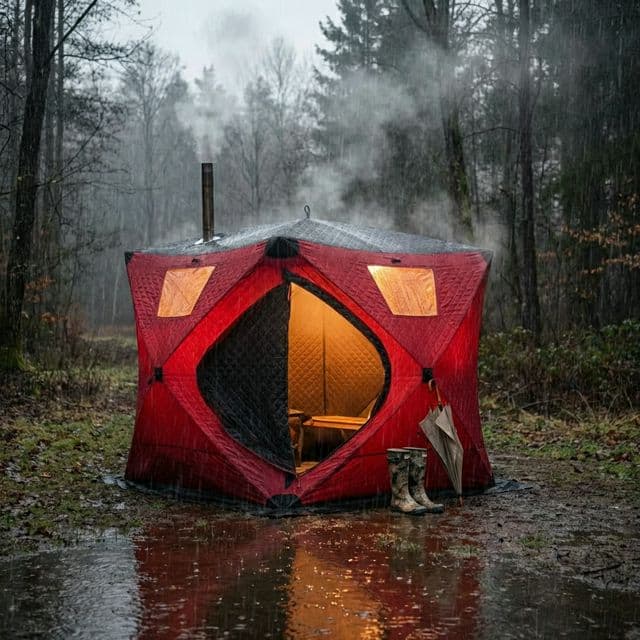
Useful reminder that moisture management remains critical in humid conditions.
Send your tool output, model candidates, room dimensions, and circuit details to [email protected]. We return a prioritized path with fit flags, risk notes, and fallback options.
Frequently asked decision questions
Email [email protected] with your inputs and candidate products. We will respond with fit ranking, risk controls, fallback options, and a recommended sequence.