
2-Person Portable Sauna Fit Planner
Check if your room, outlet, ventilation, and routine can support a 2 person portable sauna before you spend money on a tent setup.
Default assumptions: 4 sessions/week, 25-minute sessions, 12-minute setup per session, and a warm-up sensitivity view specific to the selected sauna format.
All numeric fields are required for electric formats. Electricity rate is optional for wood-fired mode.
Tool output to report verification bridge
Use this map after running the planner. It tells you which report section validates your result before you spend money.
| Tool status | Immediate interpretation | Verify in report | Next move |
|---|---|---|---|
| Strong Fit | Space ratio, outlet headroom, and ventilation profile all clear baseline thresholds for repeatable use. | Comparison table + safety baselines + risk matrix | Shortlist 2-3 models, verify exact dimensions, and email support for setup checklist. |
| Conditional Fit | At least one variable is near a boundary (clearance, outlet margin, moisture control, or setup burden). | Methodology + safety baselines + scenario lab + unknowns | Re-run planner with conservative assumptions and validate ventilation improvements before purchase. |
| Not Fit Yet | Current setup has a high probability of reliability or safety failure if forced into daily use. | Evidence boundaries + risk matrix + mitigation paths | Pause checkout, choose lower-demand format, or solve outlet and airflow gaps first. |
Stage1b content-gap audit and fixes
This round focuses on evidence quality and decision risk, not cosmetic rewrites. Open items stay marked as pending instead of being forced into low-confidence conclusions.
| Audit area | Previous gap | Stage1b upgrade | Status |
|---|---|---|---|
| Electricity benchmark freshness | The previous benchmark row used a January 2026 summary article value, but did not show the latest table-based state spread. | Updated to EIA Table 5.6.A data for November 2025: US total 17.78 cents/kWh, state range 11.93-40.20 cents/kWh. | Closed |
| Health evidence transfer boundary | The page warned about overclaiming, but did not clearly separate Finnish/infrared evidence from portable steam tent evidence. | Added a dedicated transferability table with study population, observed outcome, and explicit portability limits. | Closed |
| High-impact household risk triggers | Heat and combustion guidance existed, but critical go/no-go triggers were not consolidated into a decision table. | Added CDC-backed risk trigger table for CO burden, pregnancy heat sensitivity, and fertility-planning constraints. | Closed |
| Setup-adherence certainty | Tool copy implied a behavior drop-off claim without a public portable-sauna dataset. | Reworded as a planning heuristic and explicitly marked as evidence-limited pending public longitudinal data. | Open - evidence pending |
What the data says before you buy a 2 person portable sauna
The planner gives immediate feasibility. This report layer adds proof: key numbers, assumptions, evidence quality, boundaries, trade-offs, and concrete next actions.
Published: February 18, 2026. Last updated: February 19, 2026. Time-sensitive statements are date-stamped in the evidence ledger.
14-27 sq ft deployed footprint
Published 2-person listings range from compact seat-in tents to larger dual-steamer enclosures. Include side clearance for hoses, zippers, and dry-out airflow.
1.2-2.4 kW electric demand
Many listings cluster around 1200W to 1500W, while dual-steamer setups can approach 2400W. Shared 15A lines are often borderline once other loads are active.
$4-$38/month electric + setup labor
Energy spend can stay low with moderate frequency. Real adoption often fails because users underestimate setup, dry-out, and cleanup minutes per session.
Ventilation discipline required every session
Portable steam formats can leave residual moisture if packed before dry-out. Ventilation and post-session drying are non-negotiable for reliable long-term use.
Oct 23, 2025 recalls covered about 79,000 units
CPSC posted recalls for Lifepro sauna blankets (about 78,000 units with 65 overheating reports and 32 burn reports) and Sauna360 outdoor hybrid saunas (about 1,000 units with 7 bench incidents).
CDC: >400 non-fire CO deaths + >100,000 ED visits per year
Combustion-adjacent use and heat-sensitive users (including pregnancy) require extra screening. A pass on space and budget does not cancel high-impact health risks.
Known hardware specs > uncertain outcome claims
Power, footprint, and electrical constraints are measurable. Broad detox or guaranteed-health claims remain context-dependent and should be treated cautiously.
Who this setup fits (and who should pause)
Use this quick guide before diving into full tables. It translates planner outcomes into audience-level fit boundaries and immediate next moves.
Homes with >=20 sq ft usable area, dedicated outlet headroom, and workable post-session dry-out routine.
Run the tool and then verify shortlist assumptions in the comparison table.
Apartments or shared-circuit setups where outlet margin and humidity controls are close to threshold.
Use conservative assumptions and request a manual support review before purchase.
No reliable ventilation, unresolved medical heat-risk concerns, or outlet profile that requires recurring workarounds.
Pause purchase and shift to a lower-load or medically cleared setup path first.
Known numbers at a glance
| Dimension | Benchmark value | Why it matters | Source |
|---|---|---|---|
| Appliance energy formula | (Wattage x hours used) / 1000 = kWh | This is the baseline formula used by the planner for electric cost estimates. | DOE Energy Saver (accessed Feb 18, 2026) |
| US residential electricity benchmark | 17.78 cents/kWh (Nov 2025) | Use your local utility rate for final budgeting because state spread is wide. | EIA Table 5.6.A (data month Nov 2025; page accessed Feb 19, 2026) |
| State electricity spread context (including noncontiguous states) | 11.93-40.20 cents/kWh (North Dakota to Hawaii, Nov 2025) | A single national average hides large rate differences that can materially change operating costs. | EIA Table 5.6.A state rows (accessed Feb 19, 2026) |
| Indoor moisture baseline | Target indoor RH 30%-50%; mold can grow when RH stays above 60% | Room moisture monitoring is part of ownership, not optional cleanup. | EPA mold and moisture control guidance (accessed Feb 18, 2026) |
| Wet-material response window | Dry wet materials within 24-48 hours when possible | Delayed dry-out raises mold-risk probability after repeated steam use. | EPA mold cleanup in your home guidance (accessed Feb 18, 2026) |
| Portable steam listing power range | Common single steamer range: 1200W-1500W | Shared outlets may work at low load but lose margin when additional appliances run. | Retail product sheets (accessed Feb 18, 2026) |
| Dual-steamer 2-person listing example | 2 x 1500W steamer, 71 x 49 x 36 in enclosure | Large dual units can exceed practical 120V/15A assumptions in many homes. | X-Vcak listing snapshot (accessed Feb 18, 2026) |
| 2-person sauna tent category example | Portable tent category includes 5 x 5 x 5.5 ft models | Even "portable" options can need larger floor area than expected. | North Shore Sauna category snapshot (accessed Feb 18, 2026) |
| Extension-cord safety baseline | Extension cords are not intended as permanent household wiring | If your setup needs recurring cord workarounds, the installation plan is weak. | CPSC extension-cord warning + business guidance (1999, 2015) |
| Recent extension-cord hazard signal | CPSC announced a 2024 recall of about 9.5 million detachable extension cords due to fire and burn hazards | Cord-related fire risk remains active in current consumer products, not only legacy incidents. | CPSC recall notice (published Mar 7, 2024) |
| GFCI baseline near water | Use GFCIs around moisture-prone areas and test monthly | Adds shock-risk protection for damp-adjacent circuits and routine checks. | CPSC GFCI fact sheet (accessed Feb 18, 2026) |
| Heat stress warning baseline | Confusion, dizziness, hot/dry skin, and fainting are escalation signals | Session protocols need stop-rules, hydration, and immediate cooling actions. | OSHA heat illness signs and first aid (accessed Feb 18, 2026) |
| Heat acclimatization ramp | Start at <=20% of target heat exposure on day 1, then increase <=20% per day | Ramp-up reduces overexposure risk in new or returning users. | NIOSH heat stress acclimatization guidance (published Jun 29, 2016) |
| Recent recall signal (Lifepro sauna blankets) | About 78,000 units recalled; 65 overheating reports, including 32 burn reports | Recall checks should be mandatory before purchase and repeated during ownership. | CPSC recall notice published Oct 23, 2025 |
| Recent recall signal (Sauna360 outdoor hybrid saunas) | About 1,000 units recalled; 7 bench-collapse incidents reported | Even premium-format installations can carry structural injury risk. | CPSC recall notice published Oct 23, 2025 |
Applicability by audience profile
| Audience segment | Fit band | Reason | Recommended next step |
|---|---|---|---|
| Home users with 20+ sq ft usable floor area, dedicated outlet, and cross-ventilation | Good fit | This setup usually supports repeatable use without constant workaround behavior. | Proceed to model shortlist and final room-measure verification. |
| Apartment users on shared 15A circuits with no spare outlets nearby | Conditional | Circuit margin may collapse when other appliances cycle, increasing trip risk. | Validate breaker map and consider lower-demand format before purchase. |
| Buyers expecting minimal setup or zero cleanup overhead | Conditional | Portable systems can demand meaningful setup and dry-out labor each session. | Pilot your routine first; if adherence drops, shift to lower-friction alternatives. |
| Users with unresolved medical, pregnancy, or heat intolerance concerns | Not suitable yet | CDC pregnancy heat guidance and cardiovascular safety guidance both indicate higher-risk groups that should avoid self-directed routine heat exposure until cleared. | Get clinician clearance before launch, especially if there is heart-disease history or pregnancy-related heat concerns. |
Product context visuals (portable use scenarios)
These representative product images help you calibrate real deployment context and space expectations before selecting a model.
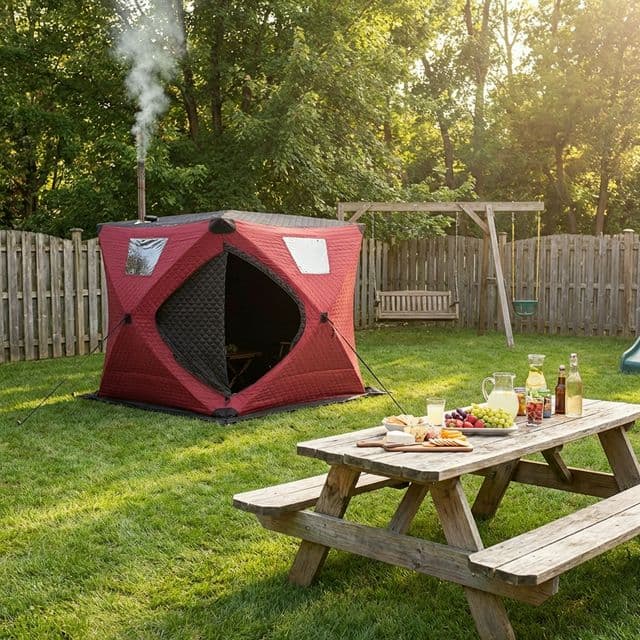
Backyard home use context for two-person routines.
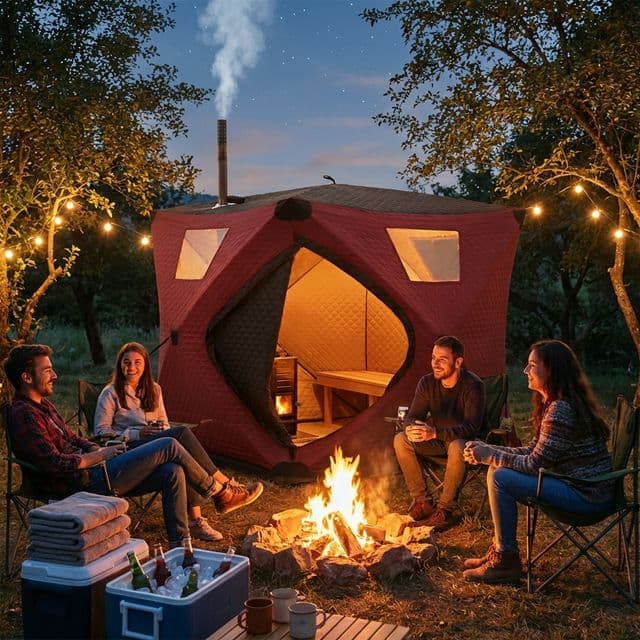
Portable format in a travel and camping scenario.
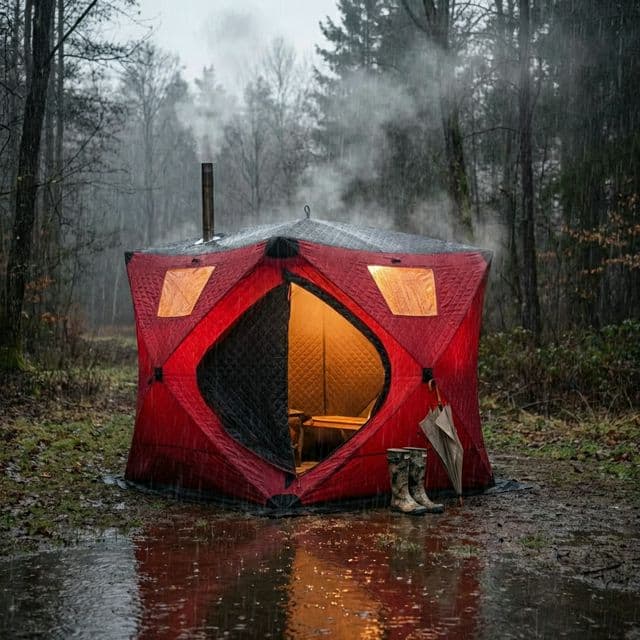
Weather-protected use case with moisture management needs.
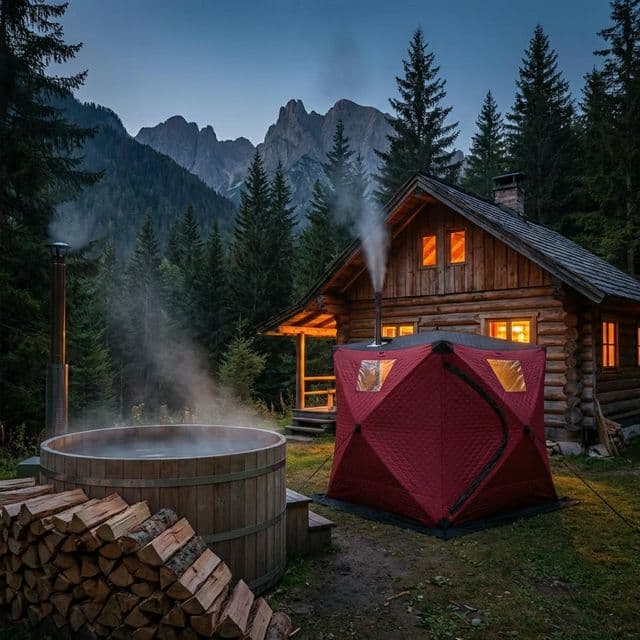
Retreat-style placement where setup and dry-out discipline matter.
Methodology and assumption controls
The planner follows a reproducible path: capture inputs, normalize to footprint and energy formulas, score boundary risk, then produce an action recommendation with uncertainty notes.
| Assumption block | Default in planner | Boundary trigger |
|---|---|---|
| Footprint estimate by format | 4.2 x 3.2 ft to 5.9 x 4.1 ft plus side clearance | Re-measure with hose and zipper access before ordering. |
| Electrical load | 1.2-2.4 kW for electric portable setups | If outlet headroom <0.2 kW, treat as borderline and re-plan power path. |
| Warm-up sensitivity | 10-18 min electric, 25 min wood-fired sensitivity window | Cold rooms and weak insulation can extend heat-up materially. |
| Setup and dry-out labor | 12 min/session baseline | Above 20 min/session is a planning-risk heuristic; verify with a two-week pilot because no public adherence benchmark exists. |
| Session frequency | 4 sessions/week | High frequency magnifies outlet and moisture control failure risk. |
| New-user acclimatization | Begin near 20% of target weekly heat exposure, then increase gradually | Rapid ramp-up increases heat-illness risk; hold progression if symptoms appear. |
Safety baselines that can invalidate a purchase plan
These controls come from regulator or standards-aligned guidance. If one baseline fails, treat the setup as not ready even if budget and space look acceptable.
| Control area | Baseline trigger | Why it matters | Fallback action | Source |
|---|---|---|---|---|
| Indoor humidity control | Keep indoor RH around 30%-50%; mold can grow when RH exceeds 60% | Steam sessions in enclosed rooms can push humidity beyond safe maintenance levels. | Add ventilation and post-session dry-out workflow before increasing session frequency. | EPA moisture control guidance (accessed Feb 18, 2026) |
| Moisture response speed | Dry wet materials within 24-48 hours when possible | Delayed drying materially increases persistent mold risk in repeated steam use. | Treat unresolved damp zones as a no-go condition until cleaned and dried. | EPA mold cleanup guidance (accessed Feb 18, 2026) |
| Wet-area electrical protection | Use GFCIs and test monthly with built-in test buttons | GFCI devices reduce shock risk when moisture and electrical equipment coexist. | Pause use and schedule electrician inspection if GFCI testing fails. | CPSC GFCI fact sheet (accessed Feb 18, 2026) |
| Extension-cord dependence | Extension cords are temporary devices, not permanent wiring | Recurring extension-cord dependence can mask outlet, gauge, or overload hazards. | Upgrade outlet path or downshift to lower-demand format before regular use. | CPSC extension-cord warning (published Jul 20, 1999) |
| Fuel-burning and CO controls | Install CO alarms on each level and outside sleeping areas; never use fuel-burning camping equipment indoors | Wood-fired or combustion-adjacent setups can create carbon-monoxide exposure risk. | Restrict to outdoor supervised operation and verify alarm coverage before use. | CPSC carbon monoxide fact sheet (accessed Feb 18, 2026) |
| Heat acclimatization ramp | Start with <=20% of day-1 target exposure and increase gradually over 7-14 days | New users and returning users have higher heat-intolerance risk without ramping. | Reduce duration/frequency immediately if dizziness, confusion, or faintness appears. | NIOSH heat stress guidance (published Jun 29, 2016) |
| Pregnancy and heat-vulnerable users | Treat pregnancy, prior heat illness, or known heat intolerance as pre-clearance conditions before routine sauna use | CDC notes higher heat-exhaustion susceptibility in pregnancy and links elevated core temperature to adverse pregnancy outcomes. | Use clinician-approved alternatives and postpone routine high-heat sessions until risk is reviewed. | CDC heat and pregnant women guidance (reviewed Apr 17, 2024) |
High-impact risk triggers users care about
These are not edge-case trivia. A setup can pass space and budget checks but still fail on household risk profile. Treat each trigger as a decision gate.
| Trigger | Evidence update | Why this changes decisions | Minimum action | Source |
|---|---|---|---|---|
| Combustion-adjacent setup (wood-fired, generator, or fuel device nearby) | CDC states that each year in the US, >400 people die, >100,000 visit emergency departments, and >14,000 are hospitalized from unintentional non-fire CO poisoning. | This is a low-frequency but high-impact failure mode that can outweigh electric-cost savings from fuel-based setups. | Keep combustion devices out of enclosed living spaces, install CO alarms on each level plus outside sleeping areas, and treat missing alarms as a no-go. | CDC carbon monoxide poisoning basics (updated Jan 12, 2026) |
| Pregnancy or known heat-vulnerable household member | CDC says pregnant women are more likely to get heat exhaustion and that elevated core temperature can be linked to birth defects and other pregnancy complications. | A plan that is mechanically feasible can still be medically inappropriate for the household profile. | Pause routine heat exposure plans and get clinician guidance before adopting frequent sessions. | CDC heat and pregnant women guidance (reviewed Apr 17, 2024) |
| Active fertility-planning window for male users | A systematic review cites a small Finnish sauna study (n=10) where sperm parameters declined after 3 months of repeated sauna and returned after 6 months of stopping. | Potential temporary fertility impact can shift the risk-benefit decision for households trying to conceive. | Treat frequent high-heat exposure as conditional risk and discuss session timing with a clinician if conception is a near-term goal. | Systematic review of Finnish + infrared sauna studies (2018) |
Health evidence transferability: what applies and what does not
This table avoids the common mistake of copying sauna health claims into portable steam buying pages without checking population, intervention type, and study limits.
| Evidence source | New data point | Portable-use applicability | Limit / counterexample |
|---|---|---|---|
| Prospective cohort (PubMed PMID 25705824) | 2,315 Finnish men followed for a median 20.7 years; compared with 1 session/week, hazard ratio for sudden cardiac death was 0.37 for 4-7 sessions/week. | Shows that frequent sauna use can correlate with long-term cardiovascular outcomes in a defined population. | Observational design cannot prove causality and the cohort does not represent portable 2-person steam tent users. |
| Systematic review (40 studies; Finnish + infrared) | Review reports potential benefits across cardiovascular and symptom outcomes, but explicitly says evidence is not enough to distinguish Finnish vs infrared outcome differences. | Supports cautious use of sauna evidence as directional context when judging wellness claims. | Review excluded steam-sauna interventions and states evidence is insufficient to prescribe exact temperature/frequency/duration for specific outcomes. |
| Adverse-effect synthesis in the same review | Most reported adverse effects were mild/moderate, but heat intolerance, hypotension, and a small male-fertility signal were documented in specific cohorts. | Reinforces the need for progressive ramp-up, symptom stop-rules, and household-specific contraindication checks. | Many studies were small and heterogeneous, so risk estimates are not portable as a universal incidence rate. |
Evidence boundary note: No reliable public trial dataset specific to two-person portable steam tents was identified in this stage1b update window.
Claim boundaries and evidence confidence
Not all claim categories deserve the same trust level. Use this matrix to separate measurable constraints from marketing statements that remain uncertain.
| Claim area | Confidence | Decision rule | Boundary / limitation | Evidence note |
|---|---|---|---|---|
| Hardware fit and electric demand | Higher confidence | Use measured room dimensions, wattage, and utility rates as primary go/no-go filters. | Listing specs still require pre-purchase reconfirmation because marketplaces update frequently. | DOE + EIA + product-sheet verification workflow |
| Safety incident and recall risk | Higher confidence | Treat CPSC recall checks as mandatory before purchase and repeat quarterly during ownership. | No single live denominator tracks all models sold across every marketplace alias. | CPSC recalls and safety notices |
| Health-improvement marketing claims | Conditional confidence | Treat disease-treatment or guaranteed-outcome claims as unverified unless claim-specific clinical evidence is provided. | FTC states some health claims may require randomized, controlled human clinical testing. | FTC health products compliance guidance |
| Cardiovascular evidence transfer to portable steam tents | Conditional confidence | Use long-term sauna health studies as directional context, not direct efficacy proof for portable 2-person steam setups. | Key cohort evidence is observational and mainly from Finnish male populations; a major systematic review also excluded steam-sauna interventions. | PubMed cohort + 2018 systematic review boundary notes |
| Portable 2-person long-term outcomes | Pending confirmation | Run a short pilot (2-4 weeks) and track adherence, humidity, and recovery outcomes before scaling spend. | No reliable public, product-level longitudinal dataset was identified in this stage1b research round. | Pending confirmation / no reliable public dataset |
Evidence ledger and source quality
Sources below are the reference stack used for claims in this page. Hardware facts and public datasets are marked as stronger evidence; marketplace listing claims are treated as directional and verified at purchase time.
Referenced Feb 18, 2026
Provides the baseline calculation method used in the tool cost model.
Open sourceData month Nov 2025; table page states next release Feb 24, 2026; referenced Feb 19, 2026
Supplies current US benchmark and state spread context for cost sensitivity tables.
Open sourceReferenced Feb 18, 2026
Provides humidity boundary context (30%-50% target range; mold growth risk above 60% RH).
Open sourceReferenced Feb 18, 2026
Provides 24-48 hour moisture response window used in dry-out risk controls.
Open sourceReferenced Feb 18, 2026
Defines GFCI purpose and monthly testing workflow for moisture-adjacent circuits.
Open sourcePublished Jul 20, 1999; referenced Feb 18, 2026
Supports boundary that extension cords are temporary, not permanent wiring paths.
Open sourcePublished Jan 7, 2015; referenced Feb 18, 2026
Adds technical wire-gauge and overload hazard context for sustained high-load devices.
Open sourceReferenced Feb 18, 2026
Supports CO alarm placement and fuel-burning safety boundaries for wood-fired scenarios.
Open sourcePage updated Jan 12, 2026; referenced Feb 19, 2026
Adds US annual burden counts (>400 deaths, >100,000 ED visits, >14,000 hospitalizations) for combustion-risk decision weighting.
Open sourceReferenced Feb 18, 2026
Defines escalation symptoms used in stop-rules and emergency thresholds.
Open sourcePublished Jun 29, 2016; referenced Feb 18, 2026
Supports progressive exposure ramp-up assumptions for new or returning users.
Open sourcePage reviewed Apr 17, 2024; referenced Feb 19, 2026
Adds household-level contraindication context for pregnancy and heat-sensitive users.
Open sourcePublished Oct 23, 2025; referenced Feb 18, 2026
Provides recent incident-count evidence that this adjacent category still requires active recall checks.
Open sourcePublished Oct 23, 2025; referenced Feb 18, 2026
Adds structural failure recall evidence beyond electric-heat incident patterns.
Open sourcePublished Mar 7, 2024; referenced Feb 19, 2026
Shows current extension-cord fire hazard signals at scale (about 9.5 million cords recalled).
Open sourceReferenced Feb 18, 2026
Defines evidence expectations for health-related marketing claims and claim substantiation.
Open sourcePublished Aug 14, 2025; referenced Feb 18, 2026
Provides clinician-caution boundaries for cardiovascular and blood-pressure risk groups.
Open sourcePublished Feb 2015; referenced Feb 19, 2026
Adds explicit cohort size, follow-up duration, and hazard-ratio context used in the transferability section.
Open sourcePublished 2018; referenced Feb 19, 2026
Documents that rigorous evidence is mixed and notes key applicability limits, including exclusion of steam-sauna interventions.
Open sourceSnapshot accessed Feb 18, 2026
Provides market examples for two-person portable tent dimensions and format options.
Open sourceSnapshot accessed Feb 18, 2026
Adds current mainstream e-commerce specification context for feature and wattage ranges.
Open sourceSnapshot accessed Feb 18, 2026
Shows high-demand dual-steamer configuration and large 2-person enclosure dimensions.
Open sourceDisclosure: Marketplace listings can change quickly. Re-check specs and warranty text directly before ordering.
Rate sensitivity and monthly cost variability
| Rate profile | Electricity rate | 1.2 kW monthly range | 2.4 kW monthly range | Interpretation |
|---|---|---|---|---|
| Low-rate utility region | 10 cents/kWh | $3-$8 / month | $6-$17 / month | Power cost is low, but setup labor remains unchanged. |
| US benchmark | 17.78 cents/kWh | $5-$16 / month | $10-$31 / month | Good default for baseline planning if local bill data is missing. |
| High-rate utility region | 26 cents/kWh | $8-$22 / month | $16-$44 / month | Dual-steamer formats become materially more expensive at high rates. |
| Cold-room sensitivity (+15 min warm-up) | 17.78 cents/kWh | $8-$22 / month | $16-$43 / month | Warm-up overhead can dominate monthly cost variance. |
Scenario lab: assumptions to outcomes
Premise: 7 x 6 ft spare area, shared 15A circuit, single 1200W steamer, window fan available.
Process: Planner score moves to Conditional Fit because outlet margin is narrow and setup burden is moderate.
Outcome: Works for low frequency if users avoid concurrent appliance load and enforce dry-out routine.
Recommended move: Keep frequency <=4 sessions/week and schedule a dedicated outlet check before scaling usage.
Premise: 10 x 8 ft room, dedicated 20A circuit, dual 1500W steamer format, cross ventilation.
Process: Space clears easily but electrical score drops due to high demand versus 120V branch limits.
Outcome: Conditional or Not Fit depending exact outlet headroom.
Recommended move: Switch to lower-demand format or move to 240V-capable infrastructure before buying dual steamers.
Premise: Outdoor setup, ample space, wood-fired tent, low electric dependency.
Process: Electrical score improves, but ventilation and combustion discipline become primary risk controls.
Outcome: Can be viable with strict operational controls and stop-rules.
Recommended move: Add CO alarms, fuel handling routine, and supervised operation checklist.
Premise: Targets low-cost 2-person claim with minimal room clearance and unknown brand specs.
Process: Budget score rises short-term, but uncertainty and durability risk increase.
Outcome: High chance of post-purchase friction or early failure.
Recommended move: Prioritize published dimensions, wattage, and support channel over headline discount.
Format comparison and trade-off table
| Option | Footprint | Power | Budget | Strengths | Trade-offs |
|---|---|---|---|---|---|
| Compact single-steamer tent | Approx 4.2 x 3.2 ft (+ clearance) | 1200W | $220-$620 | Lower power demand, easier outlet fit, lower entry price. | Less interior comfort for two adults; slower steam buildup. |
| Standard single-steamer tent | Approx 4.4 x 3.4 ft (+ clearance) | 1500W | $260-$860 | Balanced footprint and heat profile for frequent home sessions. | Still sensitive to shared-circuit load and moisture routine quality. |
| Dual-steamer 2-person enclosure | Up to ~5.9 x 4.1 ft (+ clearance) | 2400W equivalent | $420-$1300 | Faster heat-up and larger interior volume. | Higher electrical risk and larger setup footprint. |
| Portable infrared 2-person format | Approx 4.6 x 3.8 ft (+ clearance) | 1600W typical | $700-$1900 | Lower moisture burden than steam tents. | Higher upfront price and larger packed volume. |
| Wood-fired sauna tent | Approx 5 x 5 ft (+ clearance) | Low electric, combustion fuel required | $1100-$2800+ | Independent from high electric draw; outdoor portability use-case. | Combustion safety protocol and fuel logistics are mandatory. |
Risk matrix with mitigation controls
| Risk | Probability | Impact | Mitigation path |
|---|---|---|---|
| Outlet overload or nuisance trips | Medium-High | Medium-High | Verify dedicated circuit path and keep high-load appliances off the same branch. |
| Residual moisture and mildew after sessions | Medium | Medium | Enforce dry-out routine, use ventilation, and avoid storage while damp. |
| Heat intolerance or overexposure | Medium | High | Use progressive ramp-up, hydration checkpoints, and immediate stop-rules for dizziness, confusion, or fainting symptoms. |
| Low-quality listings with poor support | Medium | Medium | Prioritize published specs, clear warranty terms, and reachable support channels. |
| Combustion hazard in wood-fired setups | Low-Medium | High | Outdoor-only deployment, CO alarms on each level plus near sleeping areas, and strict supervised operation. |
| Carbon-monoxide exposure in combustion-adjacent operation | Low-Medium | Very High | Treat CO controls as mandatory: outdoor-only combustion, verified alarm coverage, and immediate stop/use-ban if alarm coverage is missing. |
| Heat-related contraindications in pregnancy or fertility-planning windows | Low-Medium | High | Apply pre-clearance screening for pregnancy and conception windows; use clinician guidance before frequent high-heat schedules. |
| Missed recall notices after purchase | Medium | High | Search CPSC recall records before purchase and re-check quarterly for model updates. |
| Planning drift from optimistic assumptions | High | Medium | Re-run planner with conservative assumptions before final purchase decisions. |
Safety boundary reminder
If your setup requires extension-cord workarounds, has unresolved moisture issues, or causes heat-intolerance symptoms, treat the current plan as "not fit yet" and escalate to manual review.
Known unknowns and how to de-risk them
| Topic | What is known | What is still uncertain | Practical action |
|---|---|---|---|
| Durability differences across low-cost listings | Spec sheets often list wattage and dimensions. | Long-term zipper, seam, and steamer reliability is frequently underreported. | Request warranty detail and after-sales channel before checkout. |
| Real-world setup time after week four | Users can complete setup quickly at first. | Behavioral adherence under routine fatigue is rarely documented. | Pilot two-week routine before committing to premium upgrades. |
| Moisture outcomes across housing types | Ventilation materially changes residual moisture risk. | No universal threshold maps every room type or climate condition. | Measure and inspect room condition after live sessions. |
| Health outcome certainty | Heat exposure can support relaxation for many users. | Pending confirmation: no reliable public, product-level portable-sauna outcome dataset was identified in this review round. | Treat use as wellness support, not deterministic treatment, and request clinician input for medical contexts. |
| Steam-tent evidence transfer from Finnish/infrared studies | A 2018 systematic review found evidence for repeated Finnish and infrared sauna interventions in select populations. | The same review excluded steam-sauna interventions, so direct transfer to portable steam tents remains limited. | Use study findings as directional context, then validate with conservative pilot sessions and model-specific monitoring. |
| Category-wide recall frequency | Portable steam recalls exist in public CPSC records. | A current complete denominator for all sold units is not publicly centralized. | Check active recalls by brand/model before purchase and during ownership. |
Freshness, scope, and evidence boundaries
Date scope: This page uses data and source snapshots available up to February 19, 2026.
Evidence scope: Hardware specs and utility rates are stronger evidence classes. Marketplace marketing claims are treated as directional unless independently verified.
Uncertainty scope: Pending confirmation: no reliable public, product-level longitudinal dataset for 2-person portable-sauna outcomes was identified in this stage1b update.
Guidance scope: This is decision support, not a substitute for electrician, building-code, or medical advice.
Need a manual fit review before checkout?
Send room dimensions, outlet details, and target usage frequency to [email protected] for a model-specific recommendation.
FAQ: high-frequency decision questions
Related paths
Disclosure: This page includes educational planning guidance only and should not be interpreted as medical, legal, or licensed electrical advice. Final installation decisions should be reviewed by qualified professionals.