
Best Home Infrared Sauna Match Tool
Get an immediate go/conditional/no-go signal using your room size, electrical setup, sauna format, and budget. Then use the report layer to validate assumptions before buying.
Default assumptions use 4 sessions per week, 30-minute sessions, and a conservative clearance baseline for home installations.
Clinical boundary reminder: CDC clinician guidance (reviewed Sep 18, 2025) highlights medication-related heat risk. If relevant, use shorter sessions and review your plan with a clinician before scaling usage.
This checker is a decision aid. Use it with model spec sheets, local code requirements, and licensed professional review.
Tool output to report verification bridge
Use this matrix right after running the checker. It maps each tool status to the report section you should verify before making a purchase decision.
| Tool status | Immediate interpretation | Verify in report | Next move |
|---|---|---|---|
| Best-Fit Tier | Your inputs clear space, electrical, and budget boundaries, so full-cabin options can be shortlisted with confidence checks. | Comparison grid + source ledger | Shortlist 2-3 candidate models, request final spec sheets, and email [email protected] for manual ranking review. |
| Contextual-Fit Tier | At least one variable sits near a boundary (area, circuit, ventilation, or budget), so assumptions need stress-testing. | Methodology + risk matrix + scenario lab | Re-run tool with conservative values and compare compact / lower-load alternatives before purchase. |
| Not-Fit Tier | Current setup carries elevated reliability or safety risk; proceeding directly to checkout is not recommended. | Fit boundaries + mitigation checklist | Pause purchase, resolve wiring/airflow constraints, or choose a phased alternative path. |
What matters most before you buy the best home infrared sauna
The tool gives instant feasibility. This report layer explains whether the recommendation is trustworthy by showing key numbers, source quality, and risk boundaries.
Published: February 21, 2026. Last updated: February 21, 2026 (stage2 SEO/GEO quality recheck). Time-sensitive data points are date-stamped in the evidence ledger.
Review cadence: refresh every 6 months, or earlier if recalls, code rules, or high-signal evidence changes.
Score weighting: fit 35% + electrical 25% + budget 20% + risk 20%
Ranking by heater type alone creates expensive misses. Home buyers get better outcomes when shortlist logic starts with room, circuit, and ventilation constraints.
17.78 cents/kWh US benchmark (Nov 2025)
National average looks manageable, but contiguous-state spread (8.24-25.91 cents/kWh) can more than triple the same usage profile.
20 RCTs mixed + selective subgroup signal
No ranking list should imply medical certainty. Buyers should treat infrared sauna as optional wellness support and keep disease-treatment claims outside decision logic.
CDC clinician guidance updated Sep 18, 2025
Diuretics, anticholinergics, and some psychotropic medications can elevate heat risk. Decision quality improves when medication screening happens before routine expansion.
79,000 recalled units + FDA warning-letter precedent
Even premium products can fail safety checks. Final selection should include recall history, claim boundaries, and local permitting assumptions.
Known numbers at a glance
| Dimension | Value | Decision implication | Source context |
|---|---|---|---|
| Appliance energy formula baseline | (Wattage x hours) / 1000 = kWh | Use this formula to verify calculator outputs and avoid inflated or undersized monthly estimates. | DOE Energy Saver (updated 2026 site context) |
| US residential electricity benchmark | 17.78 cents/kWh (Nov 2025) | Good baseline for first-pass budgeting when your utility bill is not yet available. | EIA Electricity Monthly Update (updated Jan 26, 2026) |
| State-level electricity spread | 8.24-25.91 cents/kWh (contiguous US, Nov 2025) | Same usage profile can have 3x running-cost spread by location. | EIA state range context (updated Jan 26, 2026) |
| Home heating incident baseline (portable heaters) | Average 1,600 fires / 70 deaths / 150 injuries per year (2020-2022) | Not sauna-specific, but useful as a directional signal that high-watt home heating devices need strict electrical discipline. | CPSC winter safety release (Jan 23, 2026) |
| Electrical malfunction outcomes | 23,700 fires; 305 deaths; 800 injuries (2023) | Improper household wiring can produce severe downside, not just nuisance trips. | USFA electrical trend page (reviewed Feb 14, 2025) |
| Recall + injury severity signal | 1,000 cabin units (7 incidents, 1 injury) + 78,000 blankets (65 overheating reports, 32 burns) | Use recalls as a pre-purchase gate: confirm remedy pathway, serial ranges, and safe-controller version before payment. | CPSC recalls 26-040 and 26-036 (Oct 23, 2025) |
| Premium cabin price-band reference | $6,000-$12,000 range in 2025 recalled cabin models | High upfront cost magnifies downside when infrastructure assumptions are wrong. | CPSC recall 26-040 sold-at range (Oct 23, 2025) |
| Federal tax-credit boundary | IRS 25C covers qualifying improvements placed in service after Jan 1, 2023 and before Jan 1, 2033 | Published eligible categories list insulation, windows/doors, heat pumps, etc.; no explicit sauna category listed (inference, verify with tax professional). | IRS Energy Efficient Home Improvement Credit (last reviewed Oct 24, 2025) |
| Indoor humidity boundary | Keep indoor RH below 60% (ideal 30-50%) | Ventilation and moisture control are practical decision gates for repeat home sessions. | EPA Mold Course Chapter 2 (last updated Dec 1, 2025) |
| Code-adoption boundary | U.S. has no national energy code; adoption is state/local | Permit and inspection requirements can differ by city and county, so copied forum advice is not enough. | DOE Building Energy Codes Program (accessed Feb 20, 2026) |
| Electrical requirement spread by model tier | Same brand can span 120V/20A (2-person) to 240V/20A or 30A (larger/full-spectrum configurations) | Do not assume all "home infrared" options are plug-and-play. Electrical scope can change with cabin size and heater package. | Clearlight electrical requirements + product specs (accessed Feb 21, 2026) |
| US safety-mark verification boundary | OSHA NRTL FAQ states CE mark alone is generally not accepted as US NRTL approval | Ask sellers for a recognized US listing mark and test-lab traceability before payment. | OSHA NRTL FAQ (accessed Feb 21, 2026) |
| Advertising evidence standard for health claims | FTC health guidance requires competent and reliable scientific evidence for objective health claims | Treat disease-like marketing promises as high-risk until backed by strong, claim-matched evidence. | FTC Health Products Compliance Guidance (last revised Dec 2022) |
| FDA low-risk wellness policy refresh | FDA page content current Jan 6, 2026 | General wellness positioning does not permit disease-treatment claims without device-specific clearance/approval pathways. | FDA General Wellness Policy for Low-Risk Devices (current Jan 6, 2026) |
| Contradictory health evidence in 2025 | 20-RCT review mostly non-significant pooled effects; 51-paper meta shows selective BP improvements | Treat sauna as conditional wellness support, not guaranteed medical treatment. | PMID 41049507 + PMID 41166412 |
| Null-comparator RCT signal | Heat-therapy RCT (n=41) found no significant ambulatory BP reduction | Conflicting trial design outcomes reduce certainty for universal claims. | PMID 40407037 |
| Pregnancy boundary | Avoid sauna/hot tub early pregnancy | Clinical safety boundary should override wellness experimentation. | ACOG Ask ACOG (published/reviewed Sep 2021) |
| Composite wood compliance marker | TSCA Title VI labeling required after Mar 22, 2019 | Request documentation for emission compliance on composite wood materials; EPA proposed additional standards updates in Feb 2026. | EPA formaldehyde standard page (updated with Feb 6, 2026 proposal) |
Electrical specification reality check
One common decision mistake is assuming all home infrared options share the same plug and circuit needs. This table shows model-tier deltas that can trigger rework if missed.
| Reference | Published spec | What changes | Decision gate | Source |
|---|---|---|---|---|
| Health Mate Enrich 2 (official info sheet) | 120V / 15A / 1810W, NEMA 5-15P | Entry-level cabin can stay on 15A only when room, wiring, and receptacle type match exactly. | Confirm receptacle and dedicated-circuit readiness before selecting 15A cabin SKUs. | Health Mate Enrich 2 Info Sheet |
| Clearlight Sanctuary 2 (official product page) | 120V / 20A / 2250W | A 2-person step-up can require 20A planning even when footprint remains compact. | Treat 20A as a hard prerequisite, not an optional optimization, for this profile. | Clearlight Sanctuary 2 spec page |
| Clearlight Sanctuary 3/5 family (electrical requirements) | Multiple larger models list 240V / 20A baseline requirements | Moving from compact to larger cabins can shift from 120V to 240V electrical scope. | Do not lock a larger model until panel capacity and local install path are confirmed. | Clearlight electrical requirements page |
| Clearlight full-spectrum heater upgrade note | Upgrade pathway notes 30A requirement on listed models | Optional heater packages can raise circuit demand after initial model selection. | Re-check electrical scope whenever heater package changes from baseline configuration. | Clearlight electrical requirements page |
Applicable vs not-applicable audience boundaries
This section is the fastest way to avoid misfit purchases. If your profile lands in a boundary case, follow the mitigation path before ordering.
| Profile | Applicability | Why | Next step |
|---|---|---|---|
| Homeowners with dedicated 20A line and 30+ sq ft available area | Applicable now | Can usually support compact cabin profiles without forced electrical compromises. | Move to model shortlist and final installation checklist. |
| Apartment or condo users on shared 15A circuits | Conditional | Shared branch circuits and lease constraints often limit reliable cabin operation. | Validate building/lease permissions and request electrician assessment before buying. |
| Buyers targeting full-size cabin with uncertain ventilation | Conditional | Higher draw and heat load increase sensitivity to airflow and code compliance. | Prioritize ventilation plan and consider compact format if constraints remain. |
| Users with unresolved heat-risk medical concerns or early pregnancy | Not applicable yet | Medical boundaries and clinical safety screening should take priority over purchase intent. | Obtain clinician guidance before any high-heat routine. |
Methodology and assumptions
The checker is deterministic and reproducible, but only within its stated assumptions. Review each factor before treating the result as a final go/no-go instruction.
Boundary: Area ratio below 0.86 indicates high mismatch risk
Why it matters: Home layouts often ignore maintenance access, cable routing, and door swing zones.
Boundary: Circuit ratio below 0.80 indicates no-go for stable use
Why it matters: Warm-up spikes and competing loads drive nuisance trips and thermal inconsistency.
Boundary: Outputs are heater-only and exclude fixed utility fees
Why it matters: Utility structures vary by provider, season, and tariff plan.
Boundary: No universal treatment claim without consistent high-quality trial support
Why it matters: Recent literature includes conflicting BP signals across protocol types.
Boundary: CDC-flagged medication classes move interpretation toward conditional use
Why it matters: Clinical heat tolerance can differ even when room and electrical inputs look strong.
Boundary: Evidence gaps or claim-class ambiguity are treated as unresolved decision risk
Why it matters: Marketing language quality is a practical predictor of downstream support and compliance friction.
Boundary: Unknown compliance status should be treated as unresolved risk
Why it matters: Failure modes and remedy quality are major decision variables for home users.
Replicable planner run logs
These logs show deterministic runs from the checker using declared assumptions. Re-run the same inputs to verify scoring behavior before purchase.
| Scenario | Key inputs | Tool output | Decision action |
|---|---|---|---|
| Scenario A: Homeowner ready baseline | 8 x 7.5 ft room, dedicated 120V/20A, compact cabin, 4 sessions/week, 17.8 cents/kWh | Ready Path, score 99/100, area ratio 2.21x, circuit ratio 1.26x, warm-up monthly estimate $4.39 | Proceed to vendor shortlist, then verify final model sheet and wiring with licensed support. |
| Scenario B: Apartment + shared circuit | 6 x 5.5 ft room, shared 120V/15A, compact cabin, limited ventilation, 3 sessions/week | Not Ready Yet, score 68/100, area ratio 1.21x but circuit ratio 0.68x, warm-up monthly estimate $3.62 | Pause purchase, move to lower-load profile, and confirm lease/building limits first. |
| Scenario C: Full-size usage with tight headroom | 8 x 7 ft room, dedicated 120V/20A, full-size cabin, 5 sessions/week, 25 cents/kWh | Conditional Path, score 93/100, area ratio 1.54x but circuit ratio 0.92x, warm-up monthly estimate $12.90 | Resolve circuit margin before checkout to avoid nuisance trips and unstable heat profile. |
Evidence ledger and freshness trail
Sources are listed with date markers to keep temporal context clear. Items with heterogeneous or conflicting findings are explicitly labeled in the detail column.
| Topic | What it contributes | Date marker | Link |
|---|---|---|---|
| SERP intent snapshot for keyword | Top ranking results (Feb 2026 snapshot) heavily cluster on setup guidance, running cost, and product-page comparisons, indicating blended do+know intent. | Snapshot date: Feb 20, 2026 | Source |
| Energy formula baseline | DOE defines appliance energy use as wattage multiplied by time, divided by 1000 for kWh. | Source page accessed Feb 20, 2026 | Source |
| US electricity benchmark and spread | EIA reports 17.78 cents/kWh US residential average and contiguous-state range of 8.24-25.91 cents/kWh for Nov 2025. | Updated Jan 26, 2026 | Source |
| Residential electrical malfunction severity | USFA trend page lists 2023 outcomes: 23,700 fires, 305 deaths, and 800 injuries for electrical malfunctions. | Reviewed Feb 14, 2025 | Source |
| Portable heater baseline risk + extension-cord rule | CPSC estimates annual averages of 1,600 fires, 70 deaths, and 150 injuries (2020-2022) and explicitly says electric space heaters should be plugged directly into wall outlets, not extension cords or power strips. | Release date Jan 23, 2026 | Source |
| Recall example: hybrid cabin category | Sauna360 recall covers about 1,000 units; 7 bench-break incidents and 1 injury were reported. Listed models span 120V 15A, 120V 20A, and 240V variants sold for $6,000-$12,000. | Recall date Oct 23, 2025 | Source |
| Recall example: infrared blanket category | Lifepro Bioremedy blanket recall covers about 78,000 units with 65 overheating reports and 32 reported burn injuries. | Recall date Oct 23, 2025 | Source |
| Federal tax-credit boundary for home upgrades | IRS page states the Energy Efficient Home Improvement Credit covers qualifying improvements placed in service after Jan 1, 2023 and before Jan 1, 2033. Named categories include insulation, windows/doors, and heat pumps; sauna equipment is not explicitly listed in the category summary. | Page last reviewed Oct 24, 2025 | Source |
| State/local code-adoption boundary | DOE Building Energy Codes Program states the U.S. does not have a national energy code; adoption happens at state and local jurisdiction levels, creating a patchwork. | Accessed Feb 20, 2026 | Source |
| Indoor humidity threshold | EPA mold guidance recommends indoor relative humidity below 60%, ideally 30%-50%, to limit moisture-related issues. | Last updated Dec 1, 2025 | Source |
| Heat illness warning signs | CDC guidance lists dizziness, nausea, confusion, and loss of consciousness as escalation indicators. | Last reviewed Jun 25, 2024 | Source |
| Pregnancy caution | ACOG advises against sauna/hot-tub exposure early in pregnancy due to overheating risk. | Published/reviewed Sep 2021 | Source |
| Composite wood compliance | EPA states covered composite wood products must carry TSCA Title VI labeling after Mar 22, 2019 and announced proposed voluntary-consensus standards updates on Feb 6, 2026. | Rule page updated with Feb 2026 proposal | Source |
| Infrared heart-failure evidence boundary | 2018 systematic review/meta-analysis found short-term improvements in select heart-failure outcomes using repeated 60C infrared protocols, while concluding long-term evidence is still needed. | Published Nov 2018 | Source |
| Observational mortality signal context | 2015 Finnish cohort (2,315 men, ages 42-60) found lower fatal CVD and all-cause mortality associations with more frequent sauna use; design is observational and population-specific. | Published Apr 2015 | Source |
| RCT review with mostly non-significant pooled outcomes | 2025 systematic review/meta-analysis across 20 RCTs reported mostly non-significant pooled cardiometabolic and vascular effects, with subgroup SBP findings. | eCollection Sep 2025 | Source |
| Meta-analysis with selective BP improvements | 2025 meta-analysis across 51 papers found certain BP improvements with heterogeneity and unchanged CRP/arterial stiffness. | Published Oct 30, 2025 | Source |
| Direct comparison RCT null signal | 2025 RCT in untreated hypertension (n=41) observed no significant ambulatory BP reduction from heat-therapy protocol versus comparator. | Published Jun 1, 2025 | Source |
| Model reference: Clearlight Sanctuary 2 | First-party listing includes 52 x 48 x 77 in and 120V / 20A (2,250W). | Accessed Feb 20, 2026 | Source |
| Model reference: Health Mate Enrich 2 | Official info sheet lists 47.25 x 43.5 x 77 in and 120V / 15A / 1810W (NEMA 5-15P). | Accessed Feb 20, 2026 | Source |
| Model-tier electrical variance and upgrade trigger | Clearlight electrical guidance lists 120V / 20A for Sanctuary 2, multiple larger models at 240V / 20A, and notes 30A when certain full-spectrum heater upgrades are selected. | Accessed Feb 21, 2026 | Source |
| Medication interaction and heat risk | CDC clinician guidance says medications can increase heat sensitivity and specifically flags diuretics, anticholinergics, and some psychotropic agents as risk multipliers. | Last reviewed Sep 18, 2025 | Source |
| US listing-mark verification boundary | OSHA NRTL FAQ states products certified only by foreign laboratories are not accepted unless the lab is OSHA-recognized, and CE-only context is generally insufficient for OSHA NRTL approval. | Accessed Feb 21, 2026 | Source |
| FDA wellness policy refresh | FDA guidance page says low-risk general wellness products may be marketed without active FDA regulation when claims remain in wellness scope. The page marks content current as Jan 6, 2026. | Content current Jan 6, 2026 | Source |
| FTC evidence burden for health marketing | FTC health-products compliance guidance says objective health claims require competent and reliable scientific evidence and aligns claim strength with evidence quality. | Last revised Dec 2022 | Source |
| FDA claim-boundary enforcement example | FDA warning letter states a Relax Far Infrared Ray Sauna was cleared as an infrared lamp for temporary minor pain/stiffness relief and flagged broader disease-treatment claims as unapproved/misbranded use. | Warning letter date Jul 5, 2022 | Source |
Format and alternative comparison grid
Compare at-home paths with consistent decision dimensions. If a dimension is unknown for your shortlisted model, treat it as a blocker until verified.
| Option | Setup profile | Electrical profile | Cost profile | Trade-off | Best fit |
|---|---|---|---|---|---|
| Portable blanket / low-load kit | Lowest footprint and fastest setup, often plug-and-go | Commonly 120V / lower draw profile | Lower upfront, lower session energy baseline | Lower immersion and enclosure control; recent blanket-category recalls show quality-control variance across brands. | Best for constrained apartments or phased adoption |
| Compact home cabin (1-2 person) | Moderate footprint with meaningful heat enclosure | Usually 120V / 15A-20A (for example: 1810W 15A and 2250W 20A published specs) | Mid-range purchase + moderate operating cost | Needs reliable clearance and dedicated circuit planning to avoid nuisance trips. | Balanced path for most at-home buyers |
| Full-size indoor cabin | Highest footprint and build complexity | Commonly shifts to 240V / 20A, with some heater-upgrade paths requiring 30A | High upfront and potentially higher energy sensitivity | More comfort and capacity, but failure cost rises if room/electrical assumptions are wrong. | Best for stable infrastructure and long-term committed use |
| Steam sauna alternative | Different humidity profile and maintenance needs | Can require stronger electrical and water management planning | Varies by generator specs and maintenance cycle | Humidity and cleaning demands may exceed what some indoor rooms can support. | Use when steam experience is priority over dry infrared profile |
Need a manual shortlist check before final payment?
Share room dimensions, circuit profile, and your top two models. We will flag electrical scope jumps, claim-risk issues, and unresolved compliance checks.
Risk matrix and mitigation mapping
| Risk | Probability | Impact | Early signal | Mitigation | Source |
|---|---|---|---|---|---|
| Electrical fault and fire exposure | Medium | High | Recurring breaker trips, warm receptacles, flickering lights | Use dedicated properly rated wiring and stop operation if repeated trip/heat signs appear. | USFA electrical trend page |
| Ventilation mismatch and moisture accumulation | Medium | High | Indoor RH repeatedly near or above 60%, lingering heat, discomfort escalates quickly between sessions | Add active exhaust pathway, track RH, and run shorter sessions until humidity remains in a controllable range. | EPA humidity guidance + CDC warning signals |
| Extension-cord misuse | Medium | High | Warm or coiled extension cables during operation | Plug high-watt heating devices directly into wall outlets; avoid extension cords and power strips. | CPSC Jan 2026 heating safety release |
| Heat illness escalation | Medium | High | Severe thirst, dizziness, confusion, nausea, headache | Stop session immediately, hydrate, cool down, and seek care for heat-stroke indicators. | CDC heat-illness guidance |
| Pregnancy overheating boundary | Low frequency, high consequence | High | Attempting prolonged high-heat exposure in early pregnancy | Follow ACOG guidance and prioritize clinician advice before use. | ACOG Ask ACOG Sep 2021 |
| Tax-credit assumption mismatch | Medium | Medium | Seller promises federal credits without naming a qualifying IRS category or code | Request written tax-credit basis and verify against current IRS guidance before purchase. | IRS 25C page (last reviewed Oct 24, 2025) |
| Permit/code mismatch by location | Medium | High | Advice copied from another state/city without local inspector or licensed installer validation | Confirm permit and inspection requirements with your local jurisdiction before installation. | DOE energy-code adoption framework |
| Material compliance blind spot | Low-Medium | Medium | Seller cannot provide TSCA Title VI material documentation | Request and archive compliance paperwork before purchase decision. | EPA TSCA Title VI page |
| Medical benefit over-claiming | Medium | High | Marketing language implies treatment for chronic disease, cancer, kidney, or cardiovascular conditions | Use evidence-tiered language and reject disease-treatment claims unless the exact product has explicit clearance for that indication. | FDA warning letter + mixed 2025 pooled evidence |
| Heat and medication interaction | Medium | High | User takes diuretics, anticholinergics, or psychotropic medications and reports faster fatigue, dizziness, or poor heat tolerance | Screen medication profile before high-frequency routines and align heat exposure with clinician guidance. | CDC heat-and-medications clinician guidance (Sep 18, 2025) |
| Certification-mark mismatch in US market | Medium | Medium-High | Seller provides only CE-style labeling without recognized US NRTL listing details | Request recognized US listing proof and lab traceability before payment and delivery. | OSHA NRTL FAQ (CE-only generally insufficient) |
Heat + medication screening matrix
Technical fit does not remove clinical heat risk. CDC clinician guidance shows medication patterns that should trigger conservative session planning.
| Medication pattern | Why risk rises in heat | Higher-risk users | Minimum action |
|---|---|---|---|
| Diuretics + repeated heat sessions | Fluid and electrolyte loss can accelerate dehydration and lower heat tolerance. | Users with hypertension, heart conditions, or high session frequency. | Shorten sessions, increase hydration planning, and seek clinician guidance before ramping weekly volume. |
| Anticholinergic medication use | Reduced sweating can impair heat dissipation. | Users already prone to overheating, especially in poorly ventilated spaces. | Use conservative session duration and stop immediately at early heat-illness symptoms. |
| Psychotropic medication use | Some medications can alter thermoregulation and temperature perception. | Users on multi-drug regimens or with prior heat-intolerance history. | Treat readiness as conditional until medication-specific heat guidance is reviewed. |
| Multiple risk factors combined | CDC notes heat plus medication use can significantly increase risk of harm, including severe illness. | Older adults or people with chronic conditions plus heat-sensitive medications. | Use staged acclimation and clinician-approved guardrails before routine home use. |
Source: CDC heat and medications clinical guidance (last reviewed Sep 18, 2025).
Claim governance and proof requirements
"Best" decisions break when claim class is unclear. Use this matrix to separate wellness framing, regulated medical implications, and evidence-quality expectations.
| Claim layer | What is supported | Boundary condition | Buyer action | Source |
|---|---|---|---|---|
| General wellness positioning | FDA states low-risk general wellness products can be marketed without active FDA regulation when claims stay in wellness territory. | Wellness framing does not authorize disease-diagnosis, cure, mitigation, or prevention claims. | Treat generic relaxation/recovery language separately from disease-treatment promises. | FDA general wellness policy page (content current Jan 6, 2026) |
| Objective health-claim advertising | FTC guidance requires competent and reliable scientific evidence for objective health claims. | Evidence quality must match claim strength; broad disease claims face higher substantiation burden. | Ask sellers for claim-matched human evidence, not generic testimonial bundles. | FTC Health Products Compliance Guidance (last revised Dec 2022) |
| US electrical-safety listing checks | OSHA NRTL FAQ notes products certified only by non-recognized foreign pathways (for example CE-only context) are generally not accepted as OSHA NRTL approval. | A logo without recognized US listing context is not enough to close compliance risk. | Collect NRTL listing proof and keep it with purchase records. | OSHA NRTL FAQ (accessed Feb 21, 2026) |
| Cross-brand claim-to-clearance mapping | No single public dataset maps every home infrared sauna claim to product-specific FDA clearance status. | Public-evidence gap remains for rapid cross-brand claim audits. | Mark disease-level claims as pending confirmation until exact device documentation is provided. | Pending confirmation / no reliable public crosswalk dataset |
Claim boundaries: what is supported vs what is overreach
This table separates evidence-backed outcomes from high-risk claim inflation. Use it when you evaluate ads, reseller pages, and influencer summaries.
| Claim | What evidence currently shows | Boundary condition | Decision action | Source |
|---|---|---|---|---|
| General cardiometabolic improvement for all adults | 2025 RCT review (20 trials) found mostly non-significant pooled effects across vascular and metabolic markers. | Subgroup SBP effect appears mainly in systemic whole-body heating and higher-risk populations. | Treat sauna as an optional adjunct. Track outcomes with your clinician if blood-pressure control is the goal. | PMID 41049507 (Aug 2025) |
| Blood-pressure reduction in untreated hypertension is reliable | 2025 randomized trial (n=41) found no significant ambulatory BP reduction from heat therapy versus exercise. | Small sample and protocol-specific design means no universal no-effect claim, but reliability is currently limited. | Do not replace evidence-based hypertension care with sauna-only routines. | PMID 40407037 (Jun 2025) |
| Infrared therapy supports heart-failure outcomes | 2018 review showed short-term improvements in selected heart-failure markers under repeated 60C infrared protocols. | Evidence quality ranged from moderate to insufficient, and long-term effects were explicitly noted as unresolved. | Interpret as short-term clinical signal, not a direct home-use guarantee. | PMID 30239008 (Nov 2018) |
| Frequent sauna use lowers long-term mortality for everyone | 2015 Finnish cohort found inverse associations with fatal CVD and all-cause mortality. | Observational design in middle-aged men using traditional sauna limits direct transfer to at-home infrared buyers. | Use this as directional context only; do not assume identical risk reduction for home infrared users. | PMID 25705824 (Apr 2015) |
| General wellness wording equals FDA-cleared disease use | FDA wellness guidance says low-risk wellness products can be marketed without active FDA regulation only when claims stay in wellness scope. | Wellness framing does not authorize claims to diagnose, treat, cure, mitigate, or prevent disease. | Separate lifestyle-support language from disease-treatment language before trusting marketing claims. | FDA wellness policy page (content current Jan 6, 2026) |
| Testimonials alone are enough for objective health claims | FTC guidance requires competent and reliable scientific evidence for objective health claims. | Anecdotes and influencer stories are not equivalent to claim-matched scientific substantiation. | Request study-backed evidence that matches the exact promised outcome and user population. | FTC health-products guidance (Dec 2022) |
| Infrared sauna can be marketed as a disease treatment | FDA warning letter states broader disease-treatment claims were outside cleared intended use for an infrared lamp product. | Cleared use text referenced temporary relief of minor pain/stiffness and local circulation support only. | Reject disease-cure messaging unless the exact product has specific clearance for that indication. | FDA warning letter (Jul 5, 2022) |
Policy and compliance checkpoints before payment
These are decision points that often create avoidable rework costs. Handle each checkpoint before deposit, not after delivery.
| Checkpoint | What is known | Decision impact | Minimum action | Source |
|---|---|---|---|---|
| Federal tax-credit expectation | IRS 25C page lists qualifying categories and says covered improvements are those placed in service after Jan 1, 2023 and before Jan 1, 2033. | Sauna equipment is not explicitly named in the listed categories (inference), so projected payback can be overstated. | Request exact tax-credit category + QMID from seller and confirm with a tax professional before purchase. | IRS 25C page (last reviewed Oct 24, 2025) |
| Permit and inspection assumptions | DOE states the U.S. has no national energy code and adoption occurs at state/local jurisdiction level. | Advice from another state may fail locally and can delay installation or trigger costly rework. | Validate local permitting, electrical, and inspection requirements before paying deposits. | DOE Building Energy Codes Program (accessed Feb 20, 2026) |
| Claim type and evidence burden | FDA wellness policy and FTC health-claim guidance create different boundaries for wellness framing versus disease-level claims. | Overstated disease claims can distort expected outcomes and increase regulatory/compliance risk. | Require claim-specific human evidence and product intended-use documentation before accepting therapeutic promises. | FDA Jan 2026 wellness policy + FTC Dec 2022 guidance |
| US listing-mark verification | OSHA NRTL FAQ states CE-only context is generally not equivalent to recognized US NRTL approval. | Import-style listings without recognized US traceability can leave unresolved safety/compliance questions. | Ask for recognized US NRTL listing evidence and archive it with purchase files. | OSHA NRTL FAQ (accessed Feb 21, 2026) |
| Product safety drift over time | Recent CPSC recalls include cabin bench-collapse and blanket-overheating hazards with injury reports. | Even premium or popular products can have post-sale safety corrections that alter ownership risk. | Check recall databases by model and serial range immediately before checkout and again at delivery. | CPSC recalls 26-040 and 26-036 |
| Medication and heat tolerance assumptions | CDC clinical guidance notes several medication classes can increase heat sensitivity and risk in hot conditions. | A technically valid room/circuit setup can still be a poor fit if medication-related heat risk is ignored. | Screen medication profile before increasing session duration or weekly frequency. | CDC heat and medications guidance (last reviewed Sep 18, 2025) |
| Material compliance updates | EPA TSCA Title VI labeling remains required and EPA announced additional proposed standards updates in Feb 2026. | Compliance paperwork can age; older marketing PDFs may not match current rule status. | Ask for current TSCA Title VI documentation tied to manufacturing date and supplier lot. | EPA formaldehyde standards page |
Known unknowns and pending confirmations
We do not force conclusions where reliable public evidence is limited. Use this list to identify what still needs confirmation.
| Decision question | Status | Why unresolved | Minimum handling path |
|---|---|---|---|
| Large long-duration RCTs in at-home infrared users (>6 months) | Evidence gap (public data limited) | Current high-visibility trials are mostly short intervention windows and mixed protocol designs. | Treat long-term outcome claims as provisional and re-check evidence before annual renewals/upgrades. |
| Brand-level long-term failure rates for home infrared cabins | No reliable public dataset | No public regulator dataset provides standardized cross-brand failure incidence for normal home use. | Collect warranty terms, incident logs, and recall history by exact model before purchase. |
| Single nationwide permit checklist for sauna installation | No single national checklist | Code adoption and enforcement occur at state/local levels, producing jurisdiction-specific requirements. | Confirm your local authority requirements and keep written approval records before installation work. |
| Universal medical-response profile for all user groups | Pending confirmation | Published results differ by population, protocol intensity, and comparator choice across studies. | Use conservative session plans and escalate only with clinician-aligned monitoring for high-risk users. |
| Single public registry that maps sauna marketing claims to device-specific FDA clearance status | No reliable public dataset | Regulatory, advertising, and product-listing evidence are fragmented across multiple systems and documents. | Request claim-specific intended-use and clearance documentation for each shortlisted model. |
Scenario lab: assumption to process to result
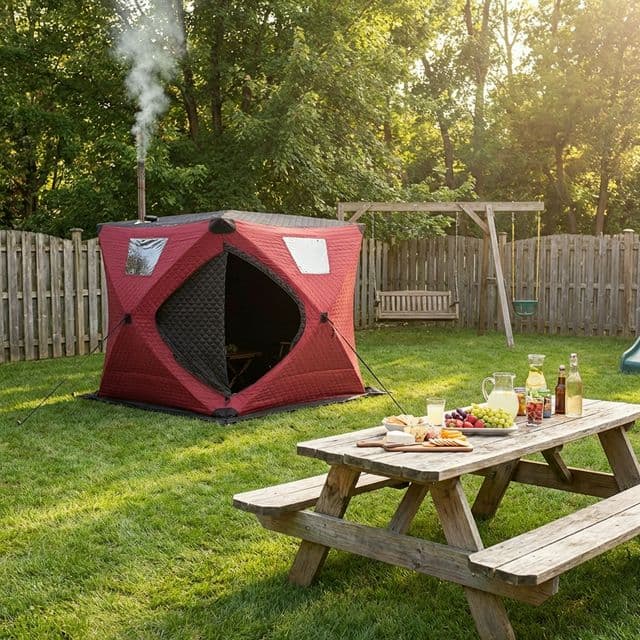
Process: Tool outputs Ready Path; buyer compares compact and full-size cabin profiles and checks recall/compliance records.
Result: Purchase proceeds with electrician verification and monthly cost stays close to estimate range.
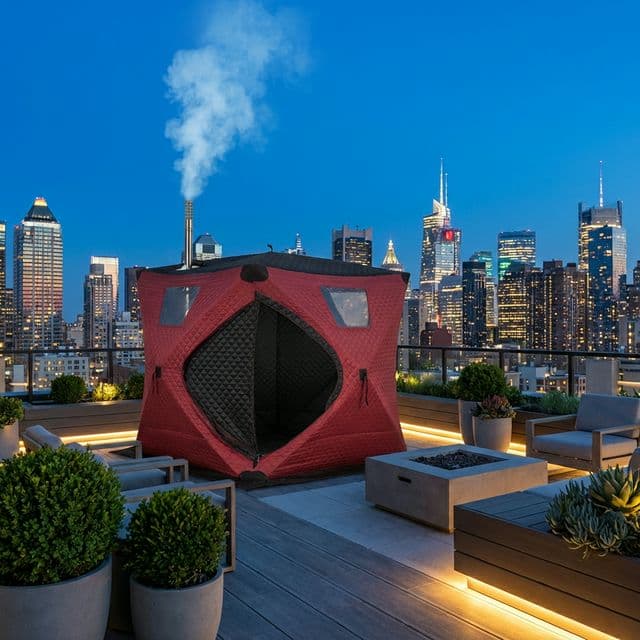
Process: Tool outputs Conditional/Not Ready; user tests lower-load profile and verifies lease restrictions before deposit.
Result: Buyer delays cabin setup, adopts phased lower-load path, and avoids infrastructure rework.

Process: Tool highlights cost sensitivity and boundary risks; report layer reframes health expectations using mixed 2025 evidence.
Result: User shortens sessions, tracks tolerance, and keeps expectations aligned with evidence uncertainty.
At-home planning image references
Visual context helps avoid unrealistic expectations around footprint, placement, and shared-home usage patterns.
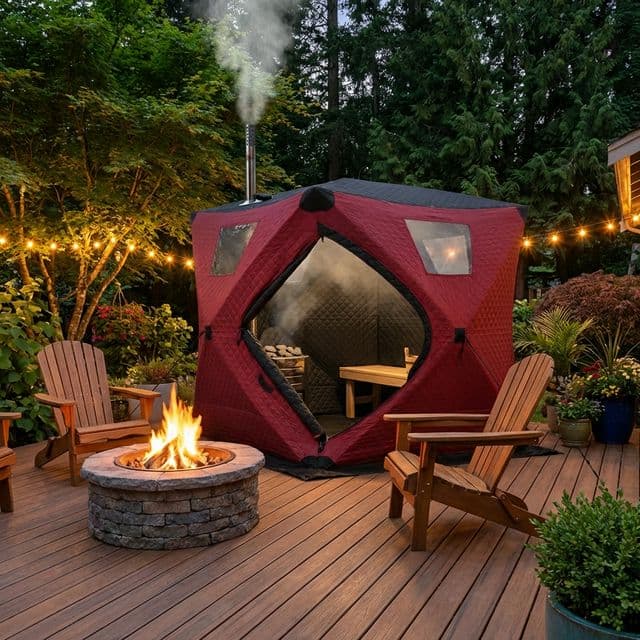
Backyard context for homeowner installation planning.
Backyard best home infrared sauna setup context for private homeowners
Shared-household planning scenario.
Family discussing an at-home sauna plan in a residential yard
Apartment/urban constraint scenario reference.
Compact sauna setup concept near an urban rooftop residence
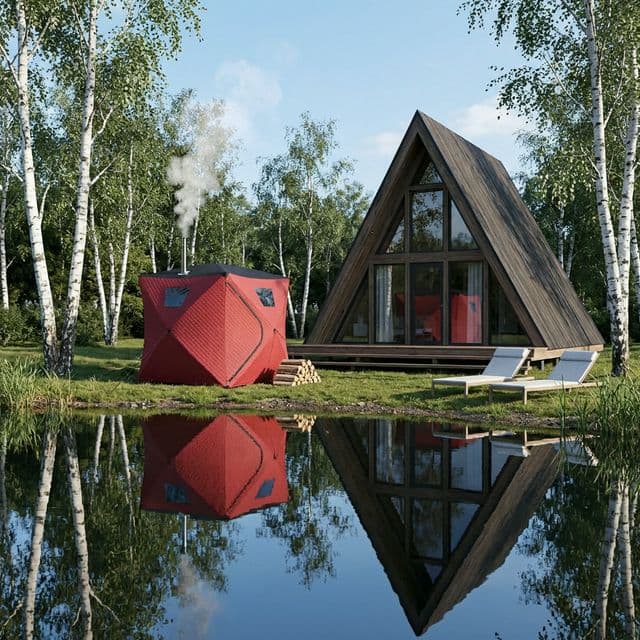
Cabin-style placement and clearance visualization.
Infrared sauna visual near a compact cabin-style home environment
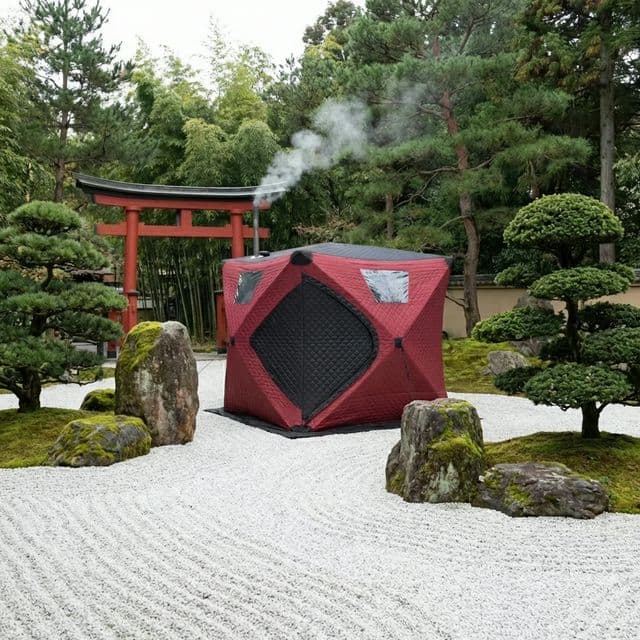
Low-distraction routine environment example.
Quiet home-garden sauna environment for regular wellness usage
Related pages to continue research
- Comparing traditional wood-heater workflows? Open the best wood burning sauna stove hybrid selector + report.
- Need a tent-only home option before fixed-installation cabins? Open the best sauna tent for home hybrid page.
- Need a broader sauna tent comparison before locking home-only assumptions? Use the best sauna tent hybrid selector + report.
- Need weather and yard-specific ranking? Open the best outdoor sauna hybrid page.
- Need cross-format ranking across portable, tent, and cabin tiers? Open the best infrared sauna hybrid selector + report
- Need a portable-only shortlist with 2024 buying intent? Open the best portable sauna 2024 hybrid selector + report.
- Need an evergreen portable-first recommendation path? Open the best portable sauna hybrid page.
- Need a home-setup-first portable workflow? Use the best portable sauna for home tool + report.
- Need installation-first feasibility before model ranking? Use the at-home infrared sauna readiness page
- Need outcome evidence before purchase? Use the benefits of infrared sauna checker + report
- Need cabin-specific sizing? Open the 2-person infrared sauna planner
- If you are circuit-limited, compare the lower-load path in the 2-person portable sauna planner
- Compare humidity-heavy alternatives in the 2-person steam sauna hybrid guide
- Need bigger capacity or outdoor placement? Review the 4-person outdoor sauna planner
- View available product styles and footprints in the gallery
- Read buying guides, maintenance updates, and product notes in the blog
- Submit a room layout for manual support from our team
- See sourcing, quality-control, and support standards
- Review general pre-purchase FAQ coverage on the homepage
Decision FAQ
Questions are grouped by decision intent so you can move from uncertainty to the next actionable step.
Send your setup details for a manual decision review
Include room dimensions, circuit details, and your preferred sauna profile. We will map your setup to practical options and highlight any unresolved risks.
Educational guidance only. This page is not medical advice, electrical code certification, or engineering sign-off.