
Published: February 28, 2026. Last updated: February 28, 2026 (stage2 seo-geo closure pass). Research window: February 2026 (stage1b evidence refresh included).
Time-sensitive figures are date-stamped in the evidence ledger. If data cannot be verified, it is marked as uncertain instead of presented as fact.
Use key findings to avoid false certainty and marketing-only claims.
Screen safety, medication, humidity, and recall risks before buying.
Use the scenario lab and final checklist to pick a clear next action.
Reader core questions first
Before comparing product specs, this page starts with the four decision questions that materially change outcomes. Each question maps to evidence, limits, and an action path.
Most long-term cohort evidence tracks Finnish-style dry sauna routines. Steam-specific long-term evidence is comparatively thin.
Electricity price spread and heater power ratings can create materially different monthly costs, especially for high-frequency users.
Steam-heavy setups can increase moisture-management burden and mold risk if ventilation and drying controls are weak.
Recent CPSC recalls show device-level hazards can override comfort preferences if compliance and recall checks are skipped.
Stage1b gap audit and closure actions
This enhancement pass starts with a gap audit before writing new copy. Rows below show what was underpowered and what evidence-backed increment was added in this update cycle (February 2026).
| Gap before enhancement | Decision risk if unchanged | What this update added |
|---|---|---|
| Long-term outcome signal was over-centered on one male-only 2015 cohort | Readers could overestimate certainty or miss how evidence behaves across different endpoints and mixed-sex samples. | Added 2017-2018 prospective cohorts for incident hypertension, stroke, and mixed-sex CVD mortality, with sample size and follow-up shown in-table. |
| Heat-risk advice lacked explicit session guardrails | Without concrete escalation triggers, users may misread comfort as safety and delay intervention. | Added protocol guardrails with hydration pacing, acclimatization ramp-up, and stop-now thresholds tied to CDC/NIOSH guidance. |
| Pregnancy boundary appeared only as a short FAQ mention | The decision matrix underweighted a high-impact scenario where convenience should not override risk controls. | Added an explicit pregnancy boundary row linked to ACOG guidance (published/reviewed September 2021). |
| Moisture claims mixed CDC and EPA statements without clean source split | Evidence traceability was weaker for readers validating humidity threshold vs dry-out timing. | Separated humidity-threshold context (CDC) and 24-48 hour dry-out window (EPA mold course), then updated source labels. |
Quick decision matrix
| Decision profile | Likely fit | Evidence signal | Immediate action |
|---|---|---|---|
| Budget-first renter with shared circuit and limited ventilation | Steam-leaning (conditional) | Lower power scenarios can reduce monthly cost, but moisture handling is the gating variable. | Use humidity and drying checklist before purchase; if humidity controls are weak, pause. |
| Cardio-focused buyer prioritizing evidence-backed routine | Dry-leaning | Most cohort and review-level cardiovascular signal comes from dry Finnish sauna exposure patterns. | Start with conservative frequency and monitor tolerance before scaling session length. |
| Respiratory comfort seeker using steam for symptom relief | Steam-leaning (uncertain efficacy) | Cochrane evidence on heated humidified air for common cold is low certainty and mixed. | Treat steam as comfort support, not disease treatment; stop if symptoms worsen. |
| Pregnant or trying to conceive in first trimester | No automatic winner (risk-first path) | ACOG advises avoiding sauna/hot tub use early in pregnancy due hyperthermia-linked fetal risk concerns. | Use OB clinician guidance before any heat-exposure routine; default to conservative avoidance when unsure. |
| High-frequency home user planning permanent installation | Dry or steam based on infrastructure | Decision should prioritize electrical capacity, ventilation path, maintenance burden, and risk profile. | Collect electrician/HVAC constraints and email [email protected] for a manual shortlist. |
This matrix is a first-pass directional tool. Validate using evidence strength, fit boundaries, and risk matrix before purchasing.
What is supported, what is conditional, and what remains uncertain
The page intentionally separates confidence levels to prevent overclaiming. If a claim lacks sufficient evidence, it is labeled as an uncertainty or boundary condition.
Three prospective cohorts (n=1,621 to 1,688) report lower adjusted hypertension, stroke, and CVD-mortality risk at higher sauna frequency
Beyond the original 2015 cohort, later Finnish follow-up studies show consistent directionality for cardiovascular endpoints, though this still does not prove steam-vs-dry causality.
Source: PMID 28633297 (2017), PMID 29720543 (2018), PMID 30486813 (2018)
1976 comparative study (n=60) and 2014 comparative study (n=10) show physiological differences, not long-term outcomes
Small studies indicate different short-session strain patterns between dry and wet heat, but do not settle long-term superiority.
Source: PMID 1267582 (1976) and PMID 24899780 (2014)
Cochrane update (2017) found no robust consistent benefit for heated humidified air in common cold outcomes
Steam may improve subjective comfort for some users, but high-confidence disease-outcome claims are not supported by current pooled evidence.
Source: PMID 28849871 (2017 update, 6 trials, 387 participants)
EIA December 2025 residential rates: North Dakota 11.02, U.S. 17.24, California 34.71 cents/kWh
Cost differences come from both local electricity price and selected heater power draw, so the same usage pattern can produce very different monthly spend.
Source: EIA Table 5.6.A (December 2025), released February 24, 2026
CDC guidance flags heat-risk medication classes; ACOG advises avoiding sauna/hot tub exposure early in pregnancy
Even when dry or steam appears technically feasible, medication, thermoregulation, or fetal-safety context can make routine heat exposure inappropriate without clinician review.
Source: CDC Heat and Medications guidance (reviewed 2025-09-18) + ACOG Ask ACOG page (published/reviewed 2021-09)
CPSC recalls 26-036 and 26-040 report 79,000 affected units, 72 incidents, and 33 injuries combined
Hazard patterns include overheating and bench-collapse events. Safety checks should happen before purchase, not after installation.
Source: CPSC recalls dated October 23, 2025
Key numbers and decision meaning
| Dimension | Value | Decision implication | Source context |
|---|---|---|---|
| Long-term cardiovascular cohort signal | Sauna frequency 4-7 sessions/week vs 1 session/week associated with SCD HR 0.37 | The strongest long-term outcome evidence in this page comes from frequent sauna exposure patterns in a dry-sauna-dominant context. | PMID 25705824 (JAMA Intern Med, 2015) |
| Incident hypertension risk signal | Prospective cohort (n=1,621; median follow-up 24.7 years): adjusted HR 0.53 for 4-7 sessions/week vs 1 | Adds endpoint diversity beyond mortality-only analysis and strengthens frequency-response signal in dry-sauna-dominant contexts. | PMID 28633297 (Am J Hypertens, 2017) |
| Incident stroke risk signal | Prospective cohort (n=1,628; men and women): adjusted HR 0.38 for 4-7 sessions/week vs 1 | Supports broader cerebrovascular risk-reduction association, but still observational and population-specific. | PMID 29720543 (Neurology, 2018) |
| Mixed-sex fatal CVD cohort signal | Prospective cohort (n=1,688; 51.4% women): adjusted HR 0.23 for 4-7 sessions/week vs 1 | Improves external validity versus male-only cohorts, yet remains geographically concentrated (Eastern Finland). | PMID 30486813 (BMC Med, 2018) |
| Dry vs wet historical physiological test settings | Dry: 80-90 C at 50% RH; Wet: 45-50 C at 100% RH | Heat feels different by modality. Do not transfer tolerance assumptions directly between dry and steam formats. | PMID 1267582 (Arch Phys Med Rehabil, 1976) |
| Short-session comparative strain signal | Body mass loss greater in dry; rectal temperature and HR rise greater in wet in one small study | Different stress signatures exist; users with heat intolerance should start with conservative session design regardless of modality. | PMID 24899780 (Biol Sport, 2014, n=10) |
| Acute hemodynamic shift after single dry-sauna session | Experimental study (n=102, 73 C, 10-20% RH, 30 min): SBP 137 -> 130 mmHg; DBP 82 -> 75 mmHg | Cool-down and standing-up transition need planning, especially for users with dizziness or blood-pressure instability. | PMID 29269746 (J Hum Hypertens, 2018) |
| Steam for common-cold endpoint certainty | 6 trials, 387 participants, low-certainty mixed outcomes | Steam can be framed as comfort support, not an evidence-backed cure path. | PMID 28849871 (Cochrane update, 2017) |
| Residential electricity spread | Dec 2025 cents/kWh: North Dakota 11.02, U.S. 17.24, California 34.71 | Location-driven price spread can change operating cost by over 3x before accounting for device power. | EIA Table 5.6.A (released 2026-02-24) |
| Annual U.S. residential price drift | 2025 YTD 17.30 vs 2024 YTD 16.48 cents/kWh | Cost screenshots based on older rates can understate current operating expense. | EIA Table 5.6.B (released 2026-02-24) |
| Heat/medication risk classes | Diuretics, anticholinergics, psychotropic medications explicitly highlighted in clinician guidance | Modality choice is secondary when medication interactions elevate heat-risk probability. | CDC Heat and Medications guidance (reviewed 2025-09-18) |
| Hydration pacing baseline for moderate heat activity | NIOSH: 1 cup (8 oz) every 15-20 minutes; generally do not exceed 6 cups/hour | Provides a concrete starting rule for session planning instead of ad-hoc fluid intake. | NIOSH Workplace Heat Recommendations (reviewed 2026-01-28) |
| Moisture management threshold | Keep indoor humidity below 50% (CDC) and dry flood/moisture events in 24-48h | Steam setup without robust ventilation/dehumidification can raise indoor moisture risk. | CDC Mold guidance (reviewed 2024-09-26) + EPA Mold Course Chapter 2 (updated 2025-12-01) |
Longitudinal evidence expansion (new in this pass)
To reduce overreliance on a single cohort, this table adds three additional prospective datasets and keeps their limits visible.
| Endpoint | Cohort | Follow-up | Adjusted signal | Limitations | Source |
|---|---|---|---|---|---|
| Incident hypertension | Kuopio prospective cohort, men 42-60 years at baseline (n=1,621) | Median 24.7 years | Adjusted HR 0.53 (95% CI 0.28-0.98) for 4-7 sauna sessions/week vs 1 session/week | Observational design; dry-sauna-dominant cultural context; no direct steam comparator arm. | PMID 28633297 (2017) |
| Incident stroke | Kuopio prospective cohort, men and women 53-74 years (n=1,628) | Median 14.9 years | Adjusted HR 0.38 (95% CI 0.18-0.81) for 4-7 sessions/week vs 1 session/week | Stroke subtypes had uneven event counts; evidence remains association, not direct causation. | PMID 29720543 (2018) |
| Fatal cardiovascular mortality | Prospective cohort, mean age 63 years, 51.4% women (n=1,688) | Median 15.0 years | Adjusted HR 0.23 (95% CI 0.08-0.65) for 4-7 sessions/week vs 1 session/week | Geographic concentration and self-reported sauna habits limit universal transferability. | PMID 30486813 (2018) |
Evidence-strength matrix
Evidence quality is graded per question, not per modality slogan. This prevents unsupported transfer from one endpoint to another.
| Decision question | Best available evidence | Strength | Boundary / limitation | Source |
|---|---|---|---|---|
| Does regular sauna bathing correlate with lower cardiovascular mortality? | Multiple prospective Finnish cohorts with long follow-up and adjusted hazard ratios across mortality and incident-event endpoints | Moderate-High | Population and protocol context are Finnish and sauna-culture specific; direct transfer to all device formats is uncertain. | PMID 25705824, 28633297, 29720543, 30486813 |
| Does steam modality outperform dry for long-term outcomes? | Direct head-to-head studies are small and focus on short physiological responses | Low | No robust large trial demonstrates long-term superiority of steam over dry or vice versa. | PMID 1267582, PMID 24899780 |
| Are acute cardiovascular shifts large enough to require protocol guardrails? | Experimental study with pre/post measurements shows meaningful short-term BP and arterial-stiffness shifts after one sauna session | Medium | Single-session design cannot forecast long-term benefit or harm; individual tolerance varies by health status. | PMID 29269746 |
| Can steam be treated as a high-confidence treatment for respiratory infections? | Systematic review of heated humidified air for common cold | Low | Mixed and heterogeneous findings; comfort effect may exist without strong disease-outcome proof. | PMID 28849871 |
| Can operating cost be estimated reproducibly? | Government electricity tables + explicit power/usage assumptions | High for method, Medium for individual forecast | Actual bill impact depends on verified device power draw, duty cycle, and local tariff structure. | EIA Tables 5.6.A and 5.6.B |
| Are product-level safety incidents meaningful for selection? | Regulatory recall notices with reported incidents and injuries | High | Recall scope is product-specific; absence of recall does not prove zero risk. | CPSC recalls 26-036 and 26-040 |
| Can pregnancy or medication context invalidate a sauna routine even if equipment looks suitable? | Clinical/public-health guidance explicitly flags pregnancy and medication-driven heat sensitivity boundaries | High for boundary screening, Low for modality-specific superiority | Guidance is risk-avoidance focused and does not provide modality winner logic for every clinical case. | ACOG Ask ACOG (reviewed 2021-09) + CDC Heat and Medications (reviewed 2025-09-18) |
Operating-cost stress test (assumption-led)
Cost rows below are reproducible scenario math, not guaranteed bills. Formula: monthly cost = hours x heater kW x electricity rate.
| Usage profile | Power assumptions | North Dakota (11.02c) | U.S. avg (17.24c) | California (34.71c) | Interpretation note |
|---|---|---|---|---|---|
| Moderate use: 4 sessions/week x 30 min (8.66 h/month) | Steam device 1.5 kW; Dry heater 6.0 kW | Steam $1.43 / Dry $5.73 | Steam $2.24 / Dry $8.96 | Steam $4.51 / Dry $18.05 | Shows tariff spread and power-scaling effect. Verify nameplate wattage before using this as a budget decision. |
| High use: 10 sessions/week x 45 min (32.48 h/month) | Steam device 1.5 kW; Dry heater 6.0 kW | Steam $5.37 / Dry $21.48 | Steam $8.40 / Dry $33.61 | Steam $16.91 / Dry $67.63 | High-frequency users should stress-test both utility cost and circuit readiness, not only purchase price. |
| Sensitivity check: +20% duty-cycle overhead | Warm-up and real-world cycling overhead applied to both modalities | Multiply baseline by 1.2 | Multiply baseline by 1.2 | Multiply baseline by 1.2 | This buffer avoids underestimating actual costs when warm-up, door-open losses, or cold-climate placement increase run time. |
Electricity prices from EIA Table 5.6.A (Dec 2025, released Feb 24, 2026). Device power assumptions must be replaced with actual nameplate values before purchase.
Fit and no-fit boundaries by context
| Condition | Dry sauna fit | Steam sauna fit | Boundary reason |
|---|---|---|---|
| Ventilation and moisture control are limited | Usually easier to manage | Conditional or no-go | CDC mold guidance suggests strict humidity control and fast dry-out windows. Poor moisture handling can create maintenance and health risk. |
| Electrical capacity is limited (shared circuits or low service margin) | Often constrained for cabin formats | Can be easier for lower-power portable options | Home power constraints can dominate modality preference. Always verify required breaker and dedicated-line needs. |
| User has medication-driven heat sensitivity risk | Conditional | Conditional | CDC clinician guidance indicates medication interactions can raise heat-illness risk regardless of modality. |
| Pregnant or attempting conception (early pregnancy window) | Conservative no-go unless clinician-guided | Conservative no-go unless clinician-guided | ACOG advises avoiding sauna and hot tub exposure early in pregnancy because core-temperature rise can be harmful for fetal development. |
| Buyer prioritizes long-term cardiometabolic evidence signal | Stronger evidence alignment | Evidence-thin for long-term endpoints | Most longitudinal evidence in this topic area is linked to dry Finnish sauna exposure patterns. |
| Goal is symptom comfort during common cold episodes | Possible comfort support | Possible comfort support | Cochrane evidence remains mixed; neither modality should be marketed as a disease cure pathway. |
Risk matrix with mitigation actions
| Risk | Common trigger | Impact | Probability | Mitigation | Source context |
|---|---|---|---|---|---|
| Heat illness or intolerance event | Long sessions, high heat load, poor hydration, medication interactions | High | Medium | Use conservative session progression, hydration pacing, and clinician review when medication risks exist. | CDC Heat and Medications (2025-09-18), NIOSH hydration guidance (2026-01-28) |
| Moisture accumulation and mold risk (steam-heavy use) | Inadequate exhaust, poor dehumidification, delayed dry-out | Medium-High | Medium | Track room humidity, use exhaust ventilation, and maintain rapid dry-out workflow. | CDC Mold guidance (2024-09-26), EPA mold course (2025-12-01) |
| Electrical mismatch or overloaded circuits | Unverified heater draw, shared circuits, undersized wiring | High | Low-Medium | Require nameplate verification and electrician sign-off before permanent installation. | OSHA NRTL FAQ (accessed 2026-02-28) + product manual verification (manufacturer dependent) |
| Product-level hazard despite nominal fit | Skipping recall check and compliance proof before purchase | High | Low-Medium | Check CPSC database, confirm listing marks, and keep purchase records/screenshots. | CPSC recalls 26-036 and 26-040 (2025-10-23) |
| Pregnancy-related hyperthermia risk misjudgment | Treating general-audience sauna routines as safe during early pregnancy | High | Low-Medium | Use clinician-guided planning and conservative avoidance when pregnant or trying to conceive in the first trimester. | ACOG Ask ACOG (published/reviewed 2021-09) |
| Post-session dizziness or fall during recovery | Fast stand-up or abrupt exit after high heat exposure, especially in BP-sensitive users | Medium-High | Medium | Add seated cool-down transition, hydrate on schedule, and stop sessions if lightheadedness persists. | PMID 29269746 + NIOSH heat recommendations (reviewed 2026-01-28) |
Guardrails before you set session protocol
These guardrails convert public-health recommendations into practical protocol rules. They do not replace individualized clinical advice.
| Situation | Common failure trigger | Guardrail action | Source |
|---|---|---|---|
| New user starting high-heat routine | No acclimatization plan | Use a gradual ramp-up: start around 20% of usual heat workload on day 1, then increase in controlled increments. | NIOSH Workplace Heat Recommendations (reviewed 2026-01-28) |
| Moderate heat activity lasting under 2 hours | Hydration based only on thirst | Use the NIOSH baseline of 1 cup (8 oz) every 15-20 minutes; generally avoid exceeding 6 cups per hour. | NIOSH Workplace Heat Recommendations (reviewed 2026-01-28) |
| Pregnancy or first-trimester planning window | Assuming sauna safety from non-pregnant guidance | Default to risk-avoidance and discuss with OB clinician before any routine heat exposure. | ACOG Ask ACOG (published/reviewed 2021-09) |
| Weak recovery environment after sessions | Hot indoor room, no cooling path, or fan-only cooling above 90F | Use cooling environments with safe temperature control; CDC notes fans can increase body temperature when indoor conditions exceed 90F. | CDC Heat Health overview (updated 2025-07-29) |
Method and boundary disclosure
This report uses a staged method to avoid overclaiming and to keep source traceability explicit for each high-impact conclusion.
Segment user intent into evidence-first, cost-first, and comfort-first questions to avoid one-size-fits-all conclusions.
Prioritize Tier 1 sources: PubMed studies, CDC/EPA/CPSC/NIOSH/OSHA, and EIA tables. Tier 2 content is supportive only.
Separate what is proven, what is context-dependent, and what remains uncertain so readers can avoid overconfident assumptions.
Provide scenario-based recommendations and pre-purchase verification checklist instead of generic preferences.
Known unknowns (explicitly tracked)
| Unknown | Why it matters | Current status | Reader action |
|---|---|---|---|
| Large modern head-to-head RCTs comparing dry and steam long-term outcomes | Current direct comparison evidence is mostly small and short-term, so superiority claims are weak. | To be verified: no robust public large RCT identified in the February 2026 review window | Use preference-plus-risk framing, not definitive superiority language. |
| Steam-specific longitudinal cohorts with hypertension/stroke/CVD endpoints | Dry-sauna-heavy Finnish cohorts currently dominate evidence weighting, which limits modality symmetry claims. | To be verified: no steam-dominant prospective cohort with comparable follow-up found in this update cycle | Treat steam decisions as comfort/infrastructure-led until stronger long-term endpoint evidence is published. |
| Standardized U.S. household power-profile benchmarks by modality class | Cost projections can be inaccurate without validated power draw under real duty cycles. | To be verified: device power remains manufacturer-specific and must be confirmed per SKU | Collect nameplate watts and installation manual before final budgeting. |
| Steam-specific long-term cardiometabolic dose-response curves | Readers often assume evidence symmetry between dry and steam, which is not established. | To be verified: evidence gap remains after current source scan | Treat steam modality decisions as comfort/infrastructure-led unless stronger endpoint evidence appears. |
Scenario lab (from data to action)
| Scenario | Likely winner | Rationale | Next step |
|---|---|---|---|
| Apartment renter, weak bathroom exhaust, budget under $1,000 | Conditional steam setup or pause | Lower-power steam options may fit budget and circuit, but moisture control is the critical blocker. | Measure post-session humidity and ensure fast dry-out path before purchase. |
| Homeowner with dedicated wiring and cardio-risk-reduction goal | Dry sauna leaning | Long-term cardiovascular evidence is stronger for dry sauna exposure patterns. | Start with moderate frequency and monitor tolerance; escalate only if recovery remains strong. |
| User on diuretics and antihypertensive medication | No automatic winner | Medication-heat interaction risk can supersede modality preference. | Build a heat action plan with clinician input before committing to frequent sessions. |
| Pregnant user in first trimester evaluating home sauna options | Delay and seek clinician guidance | General sauna-comfort logic should not override pregnancy-specific hyperthermia risk boundaries. | Use an OB-reviewed plan first; avoid defaulting to routine heat exposure because a product is marketed as gentle. |
| Family buyer comparing online listings with unclear certifications | Delay decision until proof is complete | Recall history and listing uncertainty create avoidable downstream risk. | Confirm listing mark and recall status, then shortlist options with support review. |
Evidence ledger and source traceability
Core claims are mapped to source rows with date context. If a claim cannot be validated from high-confidence public evidence, it is labeled as to be verified in the known-unknowns section.
| Source | Supports which claim | Date context | Tier | Link |
|---|---|---|---|---|
| EIA Electric Power Monthly Table 5.6.A | State-level residential electricity prices (Dec 2025) | Released 2026-02-24 | Tier 1 | Open source |
| EIA Electric Power Monthly Table 5.6.B | 2025 vs 2024 YTD residential price drift | Released 2026-02-24 | Tier 1 | Open source |
| PMID 25705824 | Long-term sauna frequency and mortality associations | Published 2015-02-24 | Tier 1 | Open source |
| PMID 28633297 | Sauna frequency association with incident hypertension | Published 2017-11 | Tier 1 | Open source |
| PMID 29720543 | Sauna frequency association with incident stroke | Published 2018-05-29 | Tier 1 | Open source |
| PMID 30486813 | Mixed-sex cohort signal for reduced fatal CVD risk and risk-prediction improvement | Published 2018-11-29 | Tier 1 | Open source |
| PMID 24899780 | Small direct dry-vs-steam physiological comparison | Published 2014-06-05 | Tier 1 | Open source |
| PMID 29269746 | Single-session cardiovascular response (blood pressure and arterial stiffness change) | Published 2018-02 | Tier 1 | Open source |
| PMID 1267582 | Dry/wet exposure settings and short-session strain contrast | Published 1976 | Tier 1 | Open source |
| PMID 28849871 (Cochrane update) | Heated humidified air evidence limitations for common cold | Published 2017-08-28 | Tier 1 | Open source |
| CDC Heat and Medications guidance | Medication classes increasing heat sensitivity risk | Reviewed 2025-09-18 | Tier 1 | Open source |
| NIOSH Workplace Heat Recommendations | Hydration pacing and acclimatization guidance | Reviewed 2026-01-28 | Tier 1 | Open source |
| CDC Mold guidance | Indoor humidity threshold context (<=50%) | Reviewed 2024-09-26 | Tier 1 | Open source |
| EPA Mold Course Chapter 2 | Indoor humidity control baseline | Updated 2025-12-01 | Tier 1 | Open source |
| CDC Heat Health overview | Heat symptom checklist and fan-use boundary when indoor temperatures exceed 90F | Updated 2025-07-29 | Tier 1 | Open source |
| ACOG Ask ACOG | Pregnancy boundary: avoid sauna/hot tub exposure early in pregnancy | Published and reviewed 2021-09 | Tier 1 | Open source |
| CPSC Recall 26-036 | Overheating and burn-hazard incident context | Published 2025-10-23 | Tier 1 | Open source |
| CPSC Recall 26-040 | Bench-collapse fall-hazard incident context | Published 2025-10-23 | Tier 1 | Open source |
| OSHA NRTL Program FAQ | CE-mark-only limitation in U.S. listing context | Accessed 2026-02-28 | Tier 1 | Open source |
Product-context gallery (5 images)
These references help map decision criteria to realistic placement contexts. They are not a substitute for on-site ventilation, moisture, and electrical assessment.
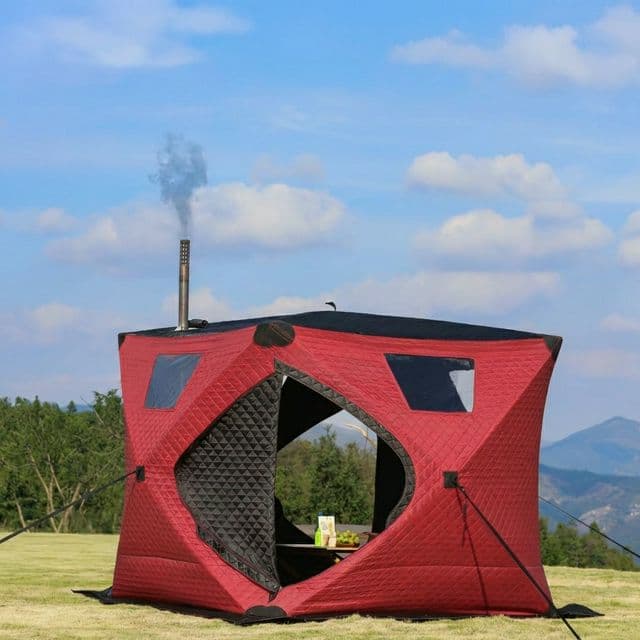
Portable sauna tent setup with clean neutral background
Compact footprint reference for space-constrained installs.
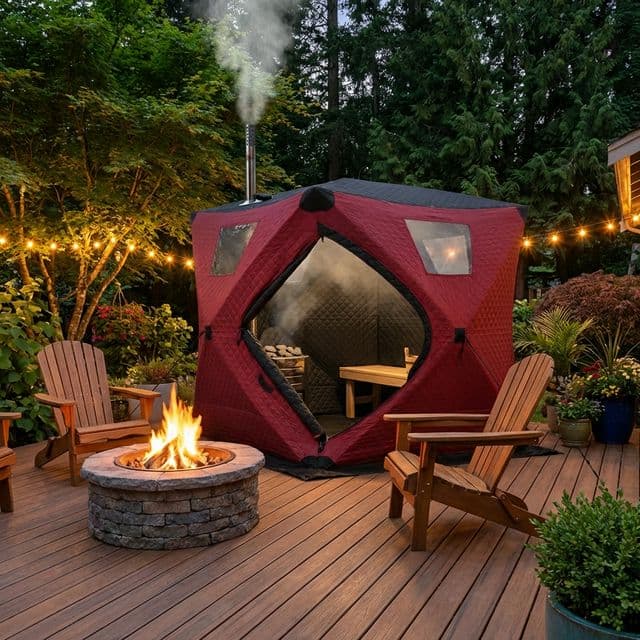
Backyard sauna tent installation example
Outdoor deployment context where ventilation and drainage planning matter.
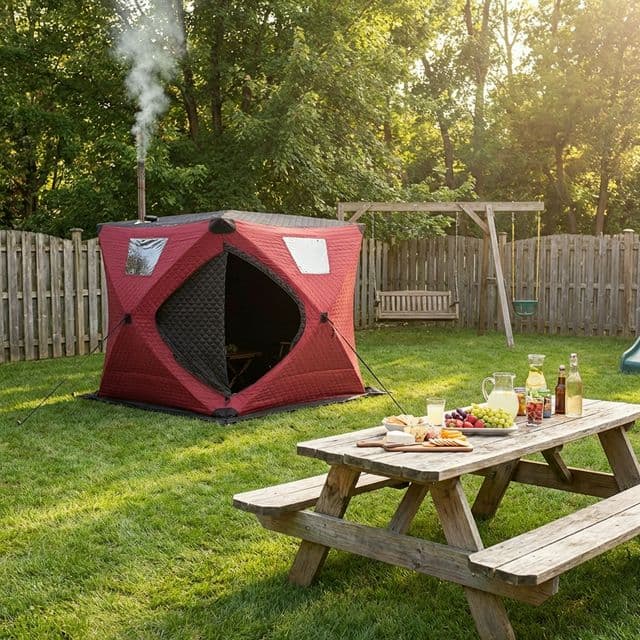
Family-friendly backyard sauna tent scene
Shared-use scenario: size, safety, and supervision planning are critical.
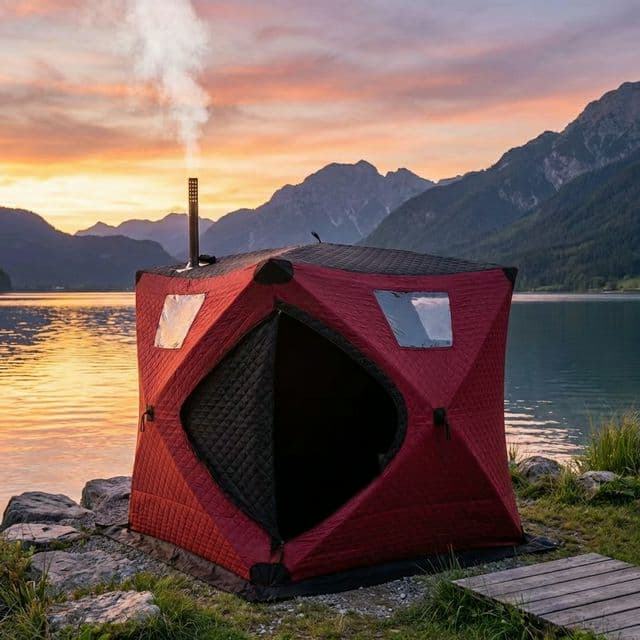
Lakeside sauna tent in open-air environment
High-humidity environments require stronger maintenance and drying routines.
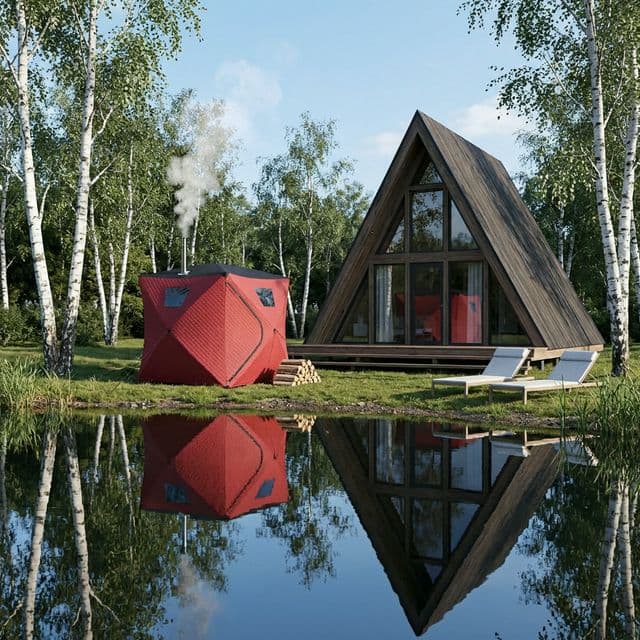
Sauna tent near cabin architecture with wooded surroundings
Cabin-style placement helps visualize dedicated power and weather exposure boundaries.
Related pages for deeper decisions
FAQ by decision intent
Confirm your goal: evidence-led outcome vs comfort-led routine.
Verify infrastructure: circuit, ventilation, and post-session dry-out capacity.
Run risk screen: medication interactions, pregnancy context, and recall/compliance checks.
Email [email protected] with your constraints for a manual shortlist and setup guidance.